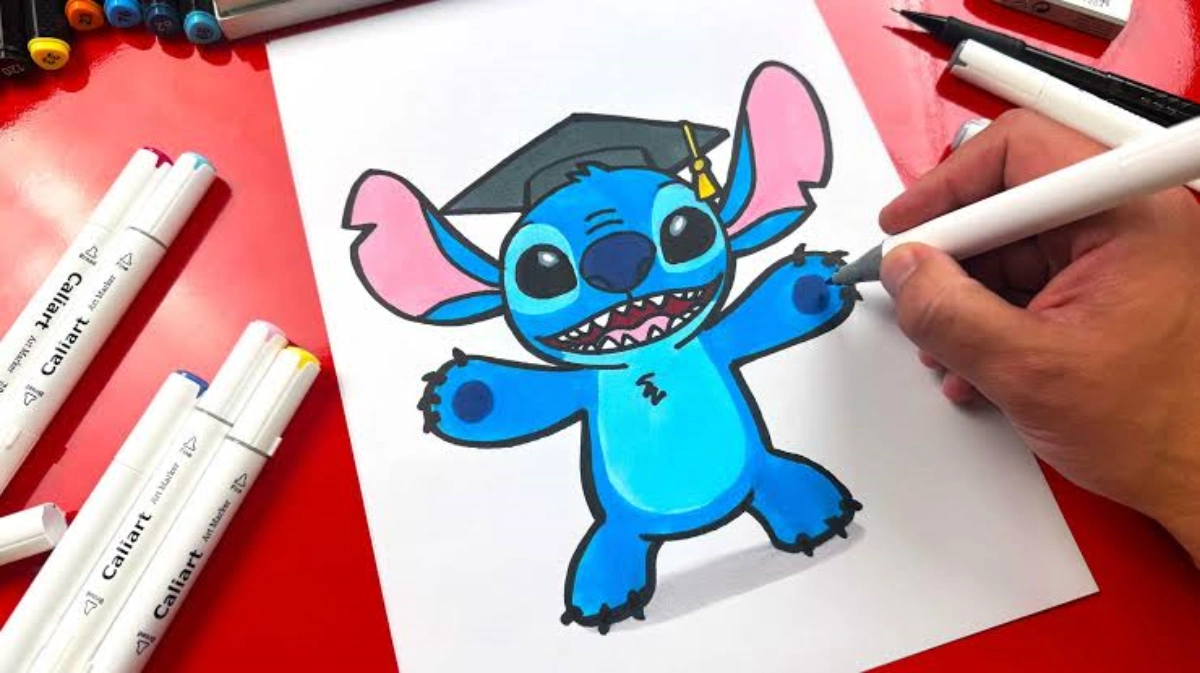
Want to learn how to draw Stitch? This beginner-friendly tutorial breaks Stitch into simple shapes so you can sketch his head, large ears, expressive face, compact body, paws, and signature blue coloring step by step.
How to Draw Stitch Easily
Start with a rounded head and compact body, then add Stitch’s large ears, close-set eyes, nose, mouth, short limbs, and signature blue coloring. Use light construction lines first and erase them after the facial features and body proportions are in place.
What You’ll Need
You don’t need professional art supplies to draw Stitch well. A few basic tools are enough to get clean results.
- Plain paper (printer paper or a sketchbook page works fine)
- A pencil for sketching guide shapes and outlines
- An eraser to clean up construction lines
- A black fine-tip marker or pen to ink the final lines
- Blue, light blue, pink, and black coloring tools (markers, colored pencils, or crayons)
Breaking Stitch Down Into Basic Shapes
Every complex character starts as a few simple shapes, and Stitch is no exception. His head is essentially a rounded oval, his body is a slightly larger rounded shape beneath it, and his limbs are thin, tapering ovals. Sketching these basic forms first, lightly and loosely, gives you a skeleton to build the details onto instead of guessing at proportions freehand.
Keep the head slightly smaller than the body, since Stitch has a compact, koala-like build rather than a tall or lanky one. Leave extra space above the head for his large ears, which take up a significant portion of his silhouette.
How to Draw Stitch Step by Step
Step 1: Draw the Head
Draw a rounded oval for the head, slightly wider at the top than the bottom. Keep the lines light because you will use the construction shape to position the facial features before cleaning it up.
Step 2: Add the Large Ears
Add two long, curved ears extending upward from the top of the head. Stitch’s ears are large and tall, roughly matching the height of the head itself, and they curve slightly outward.
As you learn how to draw Stitch, pay close attention to the ears because their size and curve have a major effect on the character’s recognizable silhouette.
Note the darker blue areas toward the ear tips as you plan the coloring.
Step 3: Add Face Guidelines
Lightly draw a vertical and horizontal guideline across the head. These lines help you place the eyes and other facial features symmetrically before you commit to the final outline.
Step 4: Draw Stitch’s Face
The face is where Stitch’s personality comes through, so take your time here.
- Draw two large, oval eyes sitting close together, slightly below the horizontal guideline. Stitch’s eyes are solid black with no visible pupils, which gives him his wide, alert expression.
- Add a small, dark nose just below and between the eyes.
- Draw a wide, expressive mouth line. A soft pink tone inside the mouth, paired with a couple of small teeth, gives Stitch his classic mischievous grin.
- Erase the guidelines once the face is placed correctly.
Step 5: Draw the Body
Draw a rounded, slightly oval body beneath the head, tapering in a little at the neck area. Keep the body compact rather than tall so the overall proportions stay consistent.
Step 6: Add the Arms and Legs
- Add two short, sturdy arms extending from the upper body, ending in small paws with a few short claws.
- Draw two short legs at the base of the body, also ending in paws with claws.
- Keep the limbs proportionally short and stubby rather than long, since Stitch’s build is compact and koala-like rather than lanky.
In his true alien form, Stitch actually has a second, smaller pair of arms tucked beneath his primary arms, along with a few small spines along his back. He keeps these retracted most of the time to look more like an ordinary dog, so you can draw him either with just the two main arms for his “disguised” look or with all four arms and back spines if you want to show his full alien design.
Step 7: Add the Tail and Antennae
Stitch has a small, stubby tail rather than a long one, so draw it as a short curved shape at the back of the body. His antennae sit on top of the head between the ears and can be drawn as two thin, slightly curved lines with small rounded tips.
Like his extra arms and spines, Stitch can retract his antennae to look more like a dog, so you can leave them out if you’re drawing his disguised look.
Step 8: Clean Up the Sketch
Once the proportions and features look right, erase the construction lines and refine the final outline.
Before moving on to coloring, check:
- Ear size and curve
- Eye spacing
- Head-to-body proportion
- Short arms and legs
- Paw and claw placement
- Small, curved tail
Taking a moment to correct these shapes now can make the finished drawing look much cleaner.
Step 9: Color Stitch
Getting the colors right makes a huge difference in how recognizable your drawing looks.
- Base color: Fill most of the body with a solid, bright blue.
- Lighter accents: Use a lighter aqua-blue tone around the eyes and running down the chin to the belly, since this softer countershading is a consistent part of his design.
- Eyes and nose: Keep these solid black for the sharpest contrast against the blue fur.
- Ear interior: A soft pink tone inside the ears adds warmth and depth to the coloring.
- Claws: A dark blue tone on the claws finishes off the paws accurately.
Once you know how to draw Stitch, these color details can help make the final result look more complete and recognizable.
Common Mistakes to Avoid
Many beginner drawings of Stitch go wrong in a few predictable places, and knowing them in advance helps you fix issues before they happen.
- Making the ears too small: Stitch’s ears are nearly as tall as his head; undersized ears make him look like a different character.
- Placing the eyes too far apart: His eyes sit close together, which is part of what gives him his expressive, alert look.
- Drawing limbs too long: Overly long arms or legs break the compact, rounded body shape that defines him.
- Skipping the light aqua countershading: Leaving the body a flat, single-tone blue makes the drawing look less accurate and less dynamic.
- Forgetting the pink ear and mouth interiors: These small color details go a long way toward making the drawing feel finished and on model.
Easy Stitch Drawing for Beginners and Kids
If the full step-by-step feels like a lot, simplify the process into four stages:
- Draw one oval for the head.
- Draw one oval for the body.
- Add two tall curved ear shapes and simple stick-like limbs with small paw shapes at the ends.
- Add two dot eyes, a small nose, and a curved mouth line.
This simplified approach keeps Stitch recognizable while removing the pressure of getting every detail exact, which works well for younger artists or a first attempt.
How to Draw Stitch’s Face
The face is one of the most important parts to check before you finish the drawing. Keep the large eyes close together, place the small nose between them, and use the mouth line to create the expression.
If the face looks off, revisit the head guidelines before changing the rest of the body. Small adjustments to the eyes, nose, and mouth can make the expression feel much more recognizable.
How to Draw Stitch’s Ears
The ears are a major part of Stitch’s silhouette. Draw them long, curved, and slightly outward from the top of the head. They are roughly as tall as the head itself, so making them too short can make the character less recognizable.
Pay attention to the darker blue areas toward the tips when you begin coloring.
Tips for a Better Stitch Drawing
- Start with light pencil lines so construction shapes are easy to erase.
- Check proportions before adding small details.
- Focus on the ears and eye placement because they strongly affect recognition.
- Keep the limbs short and the body compact.
- Use the lighter aqua countershading instead of filling the entire body with one blue tone.
- Add the pink ear and mouth interiors before considering the drawing finished.
- Practice the basic shapes first rather than trying to draw every detail at once.
Practice Your Stitch Drawing
The easiest way to improve is to repeat the basic shapes before worrying about perfect details. Start with the head and body, check the ears and eye placement, then add the smaller features and colors.
With the construction-shape method, you can make each attempt cleaner and more confident. Focus on the major proportions first, then refine the face, paws, ears, and coloring as you practice.
Read more: How Many Calories Should I Eat a Day?
Frequently Asked Questions
Most beginner-friendly tutorials break it into around six to eight stages: head, ears, face, body, limbs, tail/antennae, and coloring.
You’ll mainly need a bright blue for the body, a lighter aqua-blue for the belly and eye area, black for the eyes and nose, pink for the inner ears and mouth, and dark blue for the claws.
Yes. Because his body is made up of simple rounded shapes rather than complex angles, Stitch is considered one of the more approachable Disney characters to sketch, even for kids.
Yes. In his true alien form, Stitch, also known as Experiment 626, has a second pair of smaller arms along with back spines, all of which he can retract to disguise himself as an ordinary dog.
No. He was originally designed with green fur before the animation team changed his color to blue during production to make him look more like a believable, appealing character.
Not necessarily. Since Stitch can retract his antennae, extra arm pair, and back spines to disguise himself, both the fuller “alien” version with these features and the simpler “dog disguise” version are accurate depictions.
The ear shape and eye placement are the two details that most affect whether the drawing looks recognizable, so it’s worth double-checking these before moving on to coloring.
Yes, as long as you remember his key traits: large curved ears with darker tips, close-set black eyes, aqua countershading, a compact koala-like body, short limbs, and a stubby tail, you can draw a recognizable version from memory using the shape-based method above.