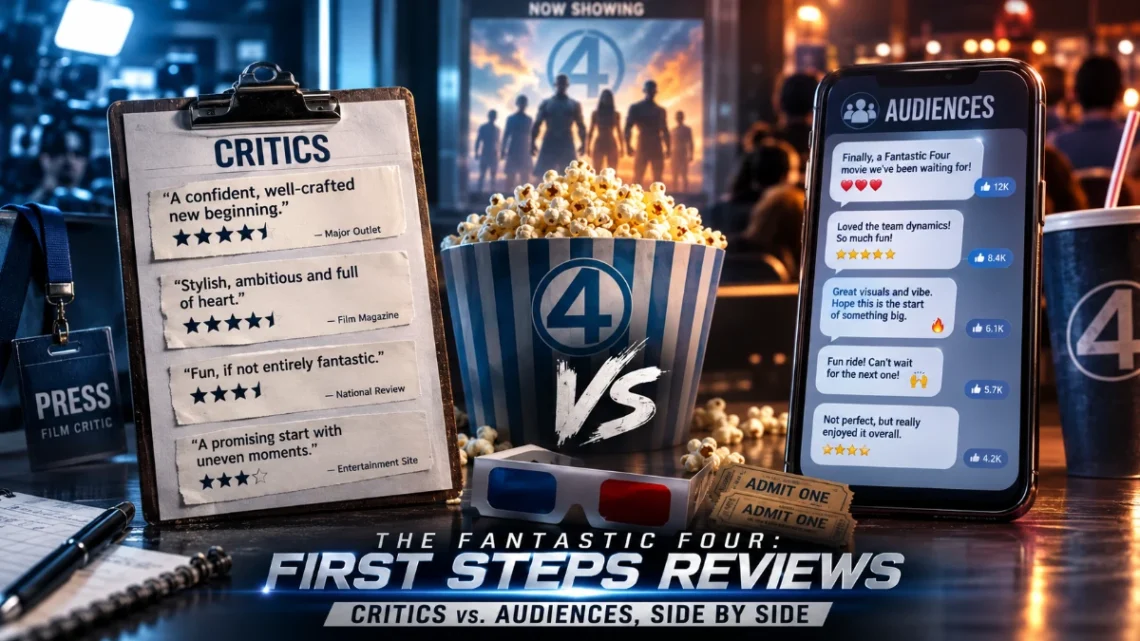
The Fantastic Four First Steps reviews are broadly positive, but the picture changes depending on which review platform you use. Rotten Tomatoes currently lists the film at 86% from 408 critic reviews and 90% from more than 10,000 verified audience ratings, while Metacritic gives it a 65/100 critic score from 54 reviews and a 6.5/10 user score from 858 ratings.
That difference makes the film more interesting than a simple “critics liked it, fans didn’t” story. Both groups respond strongly to the cast and family dynamic, while criticism is more likely to focus on the villains, script structure, and the film’s ability to generate real tension.
Fantastic Four First Steps Reviews at a Glance
| Metric | Critics | Audiences |
| Rotten Tomatoes | 86% | 90% |
| Metacritic | 65/100 | 6.5/10 |
| Metacritic sentiment | 59% positive, 35% mixed, 6% negative | 61% positive, 23% mixed, 16% negative |
| Top praise | Cast chemistry, production design, score | Family dynamic, enjoyable cast, emotional moments |
| Top criticism | Villain execution, script structure, tension | Story pacing, formulaic elements, villain execution |
The first major takeaway is that Rotten Tomatoes presents a more enthusiastic reception than Metacritic. The scores should not be treated as direct equivalents because the two sites use different scoring systems. Rotten Tomatoes reports the percentage of positive reviews or ratings, while Metacritic converts reviews into a weighted 0–100 score.
Metacritic’s critic distribution is especially useful for understanding the middle ground: 32 of 54 critic reviews are positive, 19 are mixed, and 3 are negative. Among users, 522 ratings are positive, 197 mixed, and 139 negative.
Rotten Tomatoes vs. Metacritic: Why Do the Scores Look Different?
The most revealing part of the Fantastic Four First Steps reviews is not actually a critic-versus-audience disagreement. It is the difference between review aggregators.
Rotten Tomatoes currently shows an 86% Tomatometer and 90% Popcornmeter, suggesting a strongly favorable overall response from both professional critics and audiences. Its critical consensus specifically highlights the cast chemistry and retro-1960s production design.
Metacritic is more restrained at 65/100 from critics and 6.5/10 from users, although both categories are still labeled “Generally Favorable.”
This does not mean one site is “right” and the other is “wrong.” Instead, the scores show that a large number of favorable reviews can still produce a moderate Metacritic average when several publications give the movie mixed or qualified praise.
For readers trying to decide whether the film was well received, the clearest answer is: yes, but its reception is positive rather than universally enthusiastic.
What Critics Like About The Fantastic Four: First Steps
1. The Cast Chemistry Is a Major Strength
The most consistent positive theme is the relationship among Marvel’s First Family. Rotten Tomatoes’ critics’ consensus specifically praises the cast chemistry, while early critical coverage repeatedly singled out the four leads as one of the movie’s strongest elements.
Pedro Pascal, Vanessa Kirby, Ebon Moss-Bachrach, and Joseph Quinn are presented less as four disconnected superheroes and more as a functioning family. That distinction matters because the film is built around the idea that their personal bond is as important as their powers.
This is also reflected in audience reaction. Recent Rotten Tomatoes audience comments include praise for the casting, story, and emotional impact, although some viewers also describe the story as slow or predictable.
2. The Retro-Futuristic Visual Style
The film’s 1960s-inspired world is another major critical advantage.
Rotten Tomatoes describes the movie as a retro-futuristic take on Marvel’s First Family, while its early-review roundup highlights the production design as one of the movie’s standout achievements.
The setting gives First Steps a visual identity that separates it from the more interchangeable look of some superhero productions. The Baxter Building, technology, costumes, and mid-century design help the movie feel connected to the comics while remaining distinctly cinematic.
3. Michael Giacchino’s Score
The score is another area where critics were unusually enthusiastic. Rotten Tomatoes’ roundup includes several reviews praising Michael Giacchino’s music as memorable, emotional, and instantly associated with the team.
That matters because the music reinforces the movie’s optimistic, larger-than-life tone rather than simply supporting action scenes in the background.
5 Surprising Gaps Between Critics and Fans
1. Villains Are the Most Persistent Weakness
The biggest recurring criticism concerns Galactus and Silver Surfer.
Rotten Tomatoes’ first-review roundup says the villains were “a little underwhelming,” while the review coverage repeatedly points to problems with the way the antagonists are written or developed.
The important distinction is that this should not be described as a complaint held by literally every viewer. The audience response is more varied. Some viewers praise the movie’s story and characters, while others criticize pacing, predictability, or the handling of the larger conflict.
So the safest conclusion is that villain execution is one of the most common weaknesses identified across the broader reception, not that critics and audiences unanimously disliked it.
2. Critics Focus More on Craft
Professional reviews naturally spend more time discussing production design, cinematography, score, pacing, and filmmaking choices.
That is particularly visible in the early critic coverage, which praises the retro-futuristic aesthetic and Giacchino’s score while also pointing out uneven visual effects and script issues.
Audience reviews, by contrast, are more likely to focus on whether the characters are likable, whether the story is enjoyable, and whether the family dynamic works emotionally. Metacritic’s user distribution also shows a broader spread than the critic distribution, with 16% of ratings classified as negative.
3. The Family Story Resonates More Than the Cosmic Stakes
The film’s strongest emotional material comes from the Fantastic Four functioning as a family. The cosmic threat is larger in scale, but not always more compelling.
That creates an unusual split in the reception: the movie’s human and familial elements are often more consistently praised than its villain-driven spectacle. Rotten Tomatoes’ critics’ consensus itself emphasizes the chemistry of the cast rather than the threat posed by Galactus.
4. Standalone Accessibility Is a Major Positive
One of the smartest choices in First Steps is that viewers do not need a long list of MCU films to understand the basic story.
Rotten Tomatoes’ early review coverage specifically notes the benefit of the film being separate from the rest of the MCU at launch.
That gives the movie a different kind of accessibility. New viewers can focus on the characters and central conflict instead of treating the film as homework for another franchise installment.
5. “Better Than Previous Fantastic Four Movies” Is Easier to Agree On
The film’s reception is also shaped by franchise history. Even critics who do not consider First Steps an exceptional superhero movie frequently regard it as a successful improvement over previous live-action attempts.
Rotten Tomatoes’ early review roundup describes it as succeeding where earlier Fantastic Four films faltered, while the site’s current consensus says this version does justice to Marvel’s First Family.
That does not automatically make the movie a masterpiece. It does, however, explain why its overall reputation is substantially healthier than the franchise’s earlier screen outings.
Is Fantastic Four: First Steps Worth Watching?
Yes, especially for viewers who value character chemistry, visual design, and a self-contained superhero story.
The strongest case for watching First Steps is the combination of its cast, family dynamic, retro-futuristic setting, and accessible standalone structure. The biggest caveat is that viewers expecting relentless tension or a deeply developed cosmic villain may find the central conflict less satisfying.
The review scores support that middle-ground conclusion. Rotten Tomatoes is strongly positive, while Metacritic lands in a more measured “Generally Favorable” range.
In other words, the film appears to work best when it behaves like a Fantastic Four family adventure first and a massive cosmic event second.
How It Performed at the Box Office
The Fantastic Four: First Steps grossed $521,858,728 worldwide, including $274,286,610 domestically and $247,572,118 internationally, according to Box Office Mojo.
That commercial performance reinforces the film’s broader impact, but box office alone should not be confused with review quality. A movie can perform well financially while still receiving mixed reviews, and the reverse can also happen.
For First Steps, however, the financial result and critical reception point in the same general direction: this was a successful relaunch of Marvel’s First Family, even though critics still identified weaknesses in the screenplay and villains.
Spoiler: Doctor Doom and MCU Connections
Spoiler warning: This section discusses the movie’s post-credits material.
The film connects to the wider MCU through Doctor Doom. Robert Downey Jr. appears as Doom in the post-credits sequence, with the appearance serving as a bridge toward Avengers: Doomsday. Current Marvel information lists Avengers: Doomsday for December 18, 2026, confirming that the connection is part of the active MCU slate.
That connection is important for franchise continuity, but it is not necessary to understand the main story of First Steps. The film’s core narrative remains focused on the Fantastic Four, their family relationship, Galactus, and Silver Surfer.
Final Verdict on Fantastic Four First Steps Reviews
The overall verdict is positive, with clear limitations.
The strongest elements are the cast chemistry, family-centered storytelling, retro-futuristic production design, and Giacchino’s score. The recurring weaknesses are the villains, portions of the script, and moments where the movie struggles to create the level of tension expected from a cosmic Marvel threat.
The most useful way to read the Fantastic Four First Steps reviews is therefore not as a simple critics-versus-fans argument. The broader evidence suggests a movie that won over many viewers because it finally makes the Fantastic Four feel like a believable family, while still leaving room for criticism about its plotting and antagonists.
Bottom line: The Fantastic Four: First Steps is a well-received Marvel reboot that succeeds more convincingly as a character-driven family adventure than as a perfectly constructed cosmic blockbuster.
Frequently Asked Questions
Rotten Tomatoes currently lists 86% from critics and 90% from verified audience ratings. Metacritic gives the film 65/100 from critics and 6.5/10 from users. The difference comes partly from the platforms’ different scoring methodologies.
Overall, the reviews are positive but not unanimous. Rotten Tomatoes shows a strongly positive reception, while Metacritic’s critic and user scores both fall into its “Generally Favorable” category.
Villain execution is one of the most recurring criticisms, particularly concerning Galactus and Silver Surfer. Other complaints include script structure, pacing, and a lack of tension in some major scenes.
The most consistent praise centers on the cast chemistry, family dynamic, retro-futuristic production design, and Michael Giacchino’s score.
Many critics regard First Steps as an improvement over previous live-action versions, particularly because of its stronger cast chemistry, clearer family focus, and distinctive visual identity.
No. The movie is structured as a largely accessible Fantastic Four story, and early critical coverage specifically praised its standalone quality rather than requiring extensive knowledge of the wider MCU.
Yes. While the cast and production design received strong praise, some critics objected to the screenplay’s structure, uneven pacing, and the way it handles its villains and larger conflict.
For most superhero and Marvel viewers, yes. It is particularly appealing if you value character relationships, family dynamics, strong production design, and a more self-contained MCU experience.
