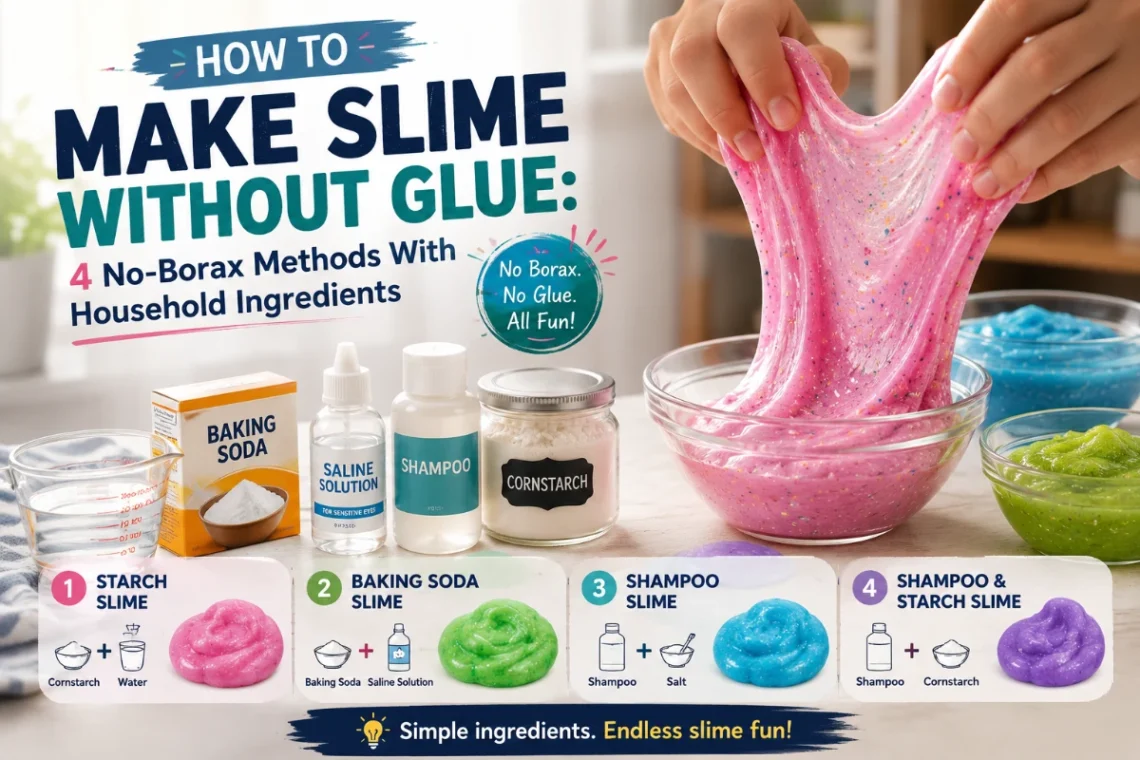
Yes, you can make slime without glue using common household items like cornstarch, shampoo, dish soap, or even psyllium husk fiber powder, and each combination produces a slightly different texture. This guide to how to make slime without glue walks through three reliable methods, plus a food-safe bonus option, troubleshooting fixes, and storage tips so a batch doesn’t dry out before you’re done playing with it.
None of these methods require white school glue or borax, the chemical activator found in traditional slime recipes. That makes learning how to make slime without glue a practical fix when the craft cupboard is empty, and it also sidesteps the skin irritation borax can cause with repeated skin contact. Anyone who’s mid-craft-session with no glue on hand can jump straight to whichever method below matches the ingredients already in the kitchen.
Cornstarch and Shampoo Slime
Of all the ways to learn how to make slime without glue, this is the closest texture to classic glue-based slime, and it only needs three ingredients: shampoo, cornstarch, and water. Thick gel shampoo or a 3-in-1 formula works best, since thinner shampoos produce a looser, less stretchy result.
Combine half a cup of thick shampoo with two and a half cups of cornstarch in a large bowl and stir until it forms a thick, crumbly paste. Water needs vary by shampoo brand, so add it gradually rather than all at once: start with about a quarter cup, stirring one tablespoon at a time, and add up to three-quarters of a cup total until the mixture shifts from crumbly to smooth and slightly stretchy.
Adding water too quickly is the most common mistake here, since it’s easy to overshoot from crumbly to runny without a firm stage in between. Once the mixture holds together, knead it by hand for a minute or two until it’s smooth rather than sticky. A few drops of food coloring stirred into the shampoo before adding cornstarch will tint the whole batch evenly.
Cornstarch and Dish Soap Slime
This is the most forgiving method for anyone learning how to make slime without glue for the first time, because the ratio tolerates small mistakes. Mix half a cup of cornstarch with one-third cup of liquid dish soap, adding the soap gradually while working it in with a spoon or your hands for about five minutes.
The result sits somewhere between playdough and traditional slime: moldable, mildly stretchy, and satisfying to squish rather than fully liquid-stretchy. If the mixture feels too sticky, sprinkle in a little more cornstarch; if it’s crumbly and won’t hold together, add a few more drops of dish soap. Thicker dish soap formulas generally produce a smoother finished texture than watery ones.
Shampoo and Salt Slime
This version uses salt as a natural thickener instead of a starch base, which makes it the fastest way to try how to make slime without glue, though also the least durable of the methods here. Salt pulls water out of the shampoo through osmosis, gradually changing its consistency from liquid to something that can be stretched and folded.
Squeeze a generous amount of shampoo into a bowl, add a similar-sized squirt of dish soap, then stir in a pinch of salt until everything is combined. Place the bowl in the freezer for 20 minutes.
When it comes out, the mixture will have firmed up enough to handle, though it softens quickly as it warms in your hands. This recipe is based on a single tested source rather than multiple independently verified accounts, so treat it as a quick experiment rather than a batch meant to last for days.
A Food-Safe Option for Toddlers
If young children are likely to put their hands, or the slime itself, in their mouths, psyllium husk powder is worth considering as a fourth way to approach how to make slime without glue. Microwave three tablespoons of psyllium husk with about one and two-thirds cups of water in a microwave-safe bowl for up to five minutes, stirring every minute to check consistency, until it turns thick and gel-like.
Let it cool for a full hour before handling, since it comes out of the microwave very hot. As with the salt method above, this ratio comes from a single documented source, so results may vary slightly by microwave wattage. Once cooled, it has a jelly-like stretch that feels distinctly different from cornstarch-based versions, and because the ingredients are food-grade, it’s a lower-risk choice for toddlers even though it isn’t meant to be eaten as a snack.
Troubleshooting Common Problems
Most slime failures come down to two issues: too sticky or too runny, and both are fixable without starting over. If the slime is too sticky or won’t stop clinging to your hands, work in a small amount of extra cornstarch, a little at a time, until it firms up.
If it’s too runny or watery, the fix depends on the method: add more cornstarch for the shampoo or dish soap versions, or return the salt-based mixture to the freezer for another 5 to 10 minutes to firm it back up. Overcorrecting by adding too much thickener at once is the most common troubleshooting mistake, so small incremental adjustments work better than large ones.
Storage and Shelf Life
Once you’ve worked out how to make slime without glue with one of the methods above, storage becomes the next question. Glue-free slime generally has a shorter shelf life than traditional glue-and-borax slime, and how long it lasts depends heavily on which method was used.
Cornstarch-based recipes tend to dry out within a day or two of regular play, while the shampoo-and-salt version softens and separates the fastest of all, sometimes within a single play session once it warms up. Store any batch in an airtight container or a zip-top bag with the air pressed out, kept at room temperature and away from direct sunlight.
If a batch starts to feel dry, kneading in a few drops of water can revive it temporarily, though eventually every glue-free recipe breaks down and needs remaking. Making smaller batches meant for one sitting is generally more practical than preserving a large batch for a week.
Safety Notes
One underrated benefit of how to make slime without glue is what it removes from the ingredient list. Skipping glue also means skipping borax, which is the main safety advantage of these recipes in the first place.
Borax has been associated with skin irritation on repeated or prolonged contact, particularly for children with eczema, cuts, or otherwise broken skin. For toddlers or children who might taste the slime, the psyllium husk method or plain cornstarch-and-water mixtures are safer choices than the soap-based versions, since dish soap and shampoo can irritate eyes and shouldn’t be ingested.
Keep glitter or small add-in beads away from children under three, since they present a choking hazard, and encourage hand-washing after any slime session, regardless of which recipe was used.
Frequently Asked Questions
Yes. All four methods here — cornstarch with shampoo, cornstarch with dish soap, shampoo with salt, and psyllium husk with water — skip both glue and borax entirely, relying instead on starch, soap, salt, or fiber to create texture.
Too much water or liquid soap was likely added too quickly. Add a small amount of extra cornstarch at a time and knead it in until the texture firms up, rather than trying to fix it with one large addition.
This usually means there’s too much liquid relative to cornstarch. Work in extra cornstarch a tablespoon at a time until the stickiness resolves, checking texture between additions.
The psyllium husk method is the safer choice for young children since its ingredients are food-grade, though it still isn’t meant to be eaten as a snack. Soap-based versions should be kept away from eyes and mouths.
It varies by method. Cornstarch-based slime typically lasts a day or two with regular play, while the shampoo-and-salt version softens fastest, sometimes within a single session, and generally can’t be stored for more than a few hours.
Yes, thicker body wash can generally substitute for shampoo in these recipes, though the final texture may be slightly different since consistency varies by brand.
Does no-glue slime stretch as well as glue-based slime?
Not usually. The cornstarch-and-shampoo method comes closest to a glue-based stretch, but most no-glue recipes are less elastic and more prone to drying out or separating.
What if I don’t have cornstarch?
The shampoo-and-salt method skips cornstarch entirely, relying on salt as a thickener instead, though it produces a less durable result than starch-based versions.
Can this slime be reused after it dries out?
Kneading in a few drops of water can temporarily revive a batch that’s started to dry, but the texture will keep degrading over time and eventually needs to be remade from scratch.