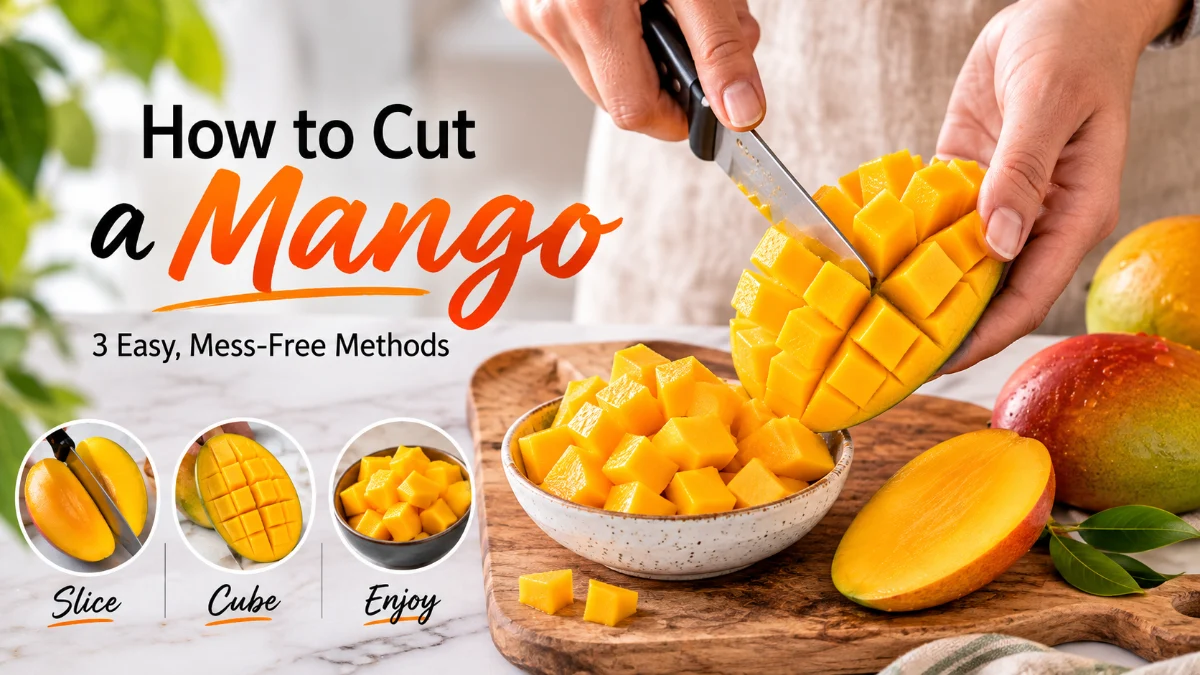
If you’ve ever wrestled with a mango and ended up with juice everywhere and half the flesh still stuck to a flat, stubborn seed, you’re not alone. Home cooks run into this problem constantly, and most kitchens settle on one of a few tried-and-tested approaches once they understand the fruit’s anatomy. Learning how to cut a mango cleanly comes down to understanding one thing: the pit sits flat and off-center inside the fruit, and once you know where it is, cutting becomes simple. Below you’ll find three reliable methods — cubes, slices, and a no-knife-skills trick — so you can pick whichever suits your kitchen setup and what you’re making.
Why Cutting a Mango Feels Tricky
Unlike round fruits with a small central core, a mango has one wide, flat, oval-shaped pit running from stem to tip. This pit sits closer to one side than the exact center of the fruit, which is why cutting straight through the middle usually means striking a bone-hard pit instead of soft flesh. Once you know the pit is flat rather than round, you can angle your knife to slide past it instead of into it, and every method for how to cut a mango builds on this same idea.
What You’ll Need
Basic tools:
- A sharp chef’s knife or paring knife
- A stable cutting board
- A spoon for scooping
Optional tools:
- A mango splitter, a dedicated tool that pops the flesh away from the pit in a single squeeze motion
- A sturdy drinking glass, useful as an improvised, no-skill substitute for the splitter in the method described later
Having the right tools ready before you start makes every step of how to cut a mango faster and less messy.
Step 1: Check Ripeness Before You Cut
A mango that’s underripe will be hard to cut cleanly, while an overripe one turns mushy and hard to control. Before you learn how to cut a mango, give it a gentle squeeze near the stem end — it should yield slightly, similar to a ripe avocado, without feeling mushy. A sweet, fruity smell at the stem, a golden-yellow blush on the skin, and a slightly wrinkled texture are all good signs the fruit is ready to cut.
Step 2: Find and Cut Around the Pit
This step is the foundation for every technique in how to cut a mango, regardless of whether you plan to make cubes or slices.
How to locate the pit:
Stand the mango upright with the stem pointing up. The flat pit runs vertically through the center, slightly closer to one of the narrower sides than the other.
Cutting the two cheeks:
Using your chef’s knife, slice downward about a quarter-inch off-center on one side, letting the blade glide past the pit rather than through it. Repeat on the other side. You’ll end up with two large, curved pieces of flesh — often called the “cheeks” — plus a thin middle piece still attached to the pit.
How to Cut a Mango Into Cubes (Hedgehog Method)
This is the most popular way to approach how to cut a mango because it turns each cheek into ready-to-eat cubes without a peeler.
- Take one mango cheek and place it skin-side down on the cutting board.
- Score the flesh in a grid pattern, cutting down to the skin but not through it.
- Turn the cheek over and gently push the skin from underneath, so the scored cubes pop outward like a hedgehog’s spikes.
- Slice the cubes away from the skin using your knife, or scoop them off directly with a spoon.
- Repeat with the second cheek.
This hedgehog method is ideal when you’re cutting a mango for snacking, fruit salads, or smoothies, since it produces uniform, bite-sized pieces quickly.
How to Cut a Mango Into Slices
If you prefer long, elegant pieces rather than cubes, slicing is a straightforward alternative for cutting a mango.
- Place a mango cheek skin-side down and slice the flesh lengthwise into strips without cutting through the skin.
- Run your knife blade between the flesh and the skin, angling it close to the peel to release each slice in one motion.
- Arrange the slices on a plate or use them for garnishing desserts and drinks.
Slicing works well when presentation matters, such as plating mango for a dessert or a fruit platter.
No-Knife-Skills Trick: The Glass Method
If grid-scoring or slicing near the skin feels intimidating, there’s a simpler shortcut that many guides skip over when explaining how to cut a mango. After cutting the two cheeks away from the pit as described earlier, take a sturdy drinking glass and press the rim firmly against the flesh side of one cheek. Push the glass downward through the flesh toward the skin, and the cubed mango pieces will pop directly into the glass, separated from the peel. This method is especially useful for beginners, kids helping in the kitchen, or anyone without confident knife skills.
Each method suits a different goal, so it helps to see them side by side before deciding which one to use.
| Method | Best For | Tools Needed | Difficulty |
| Hedgehog (Cubes) | Snacking, salads, smoothies | Chef’s knife, spoon | Easy |
| Slices | Plating, desserts, garnish | Chef’s knife | Moderate |
| Glass Trick | Beginners, kids, no knife skills | Drinking glass | Very Easy |
Don’t Waste the Mango Around the Pit
Most guides stop once the two cheeks are removed, but there’s still a good amount of flesh clinging to the pit itself. Instead of discarding it, hold the pit over a bowl and use a paring knife to trim off the remaining flesh in strips, or simply bite around it like a corn cob. This extra step means less waste every time you cut a mango, and it adds up to noticeably more usable fruit from every mango you buy.
Common Mistakes to Avoid
A few small errors account for most of the frustration people run into when learning how to cut a mango:
- Cutting straight through the center instead of angling around the flat pit, which wastes flesh and risks knife slips.
- Scoring the hedgehog cut too deep and sliced through the skin, which makes the peel harder to hold while scooping.
- Using a dull knife, which requires more pressure and increases the risk of slipping on the mango’s slick skin.
- Skipping the ripeness check, which leads to either a mushy mess or flesh too firm to cut cleanly.
How to Store Cut Mango
Once you’ve finished cutting your mango, transfer the pieces into an airtight container and refrigerate them promptly rather than leaving them at room temperature. Refrigerated cut mango generally stays fresh for a few days, and a light squeeze of lemon or lime juice can help slow browning. For longer storage, cubed mango also freezes well and works great blended straight into smoothies.
If you’re short on time, the hedgehog method is the fastest all-purpose way to cut a mango; if you want a no-mess beginner option, reach for the glass trick instead.
Read more: How Many Calories Should I Eat a Day?
Frequently Asked Questions
Yes — the hedgehog method requires no peeler. You slice off the cheeks, score the flesh into a grid, and push the skin from underneath to pop the cubes outward.
The hedgehog method is the fastest for smoothies since it produces ready-to-blend cubes in just a few cuts per cheek.
Yes, the glass trick works well here. After removing the cheeks from the pit, pressing a sturdy glass rim through the scored or plain flesh pops out clean cubes with minimal cutting precision needed.
Give it a gentle squeeze near the stem — it should yield slightly without feeling mushy. A sweet aroma at the stem and a golden-yellow blush on the skin are also good indicators.
That’s the mango’s flat pit, which sits off-center rather than in the exact middle. Angling your knife about a quarter-inch to one side of center avoids it.
Refrigerated cut mango stored in an airtight container generally stays fresh for a few days; adding a splash of lemon or lime juice can help slow browning.
Yes, cubed mango freezes well and can be blended directly into smoothies without thawing first.
The hedgehog method produces bite-sized cubes ideal for snacking or smoothies, while slicing creates longer, elegant pieces better suited for plating or garnishing.