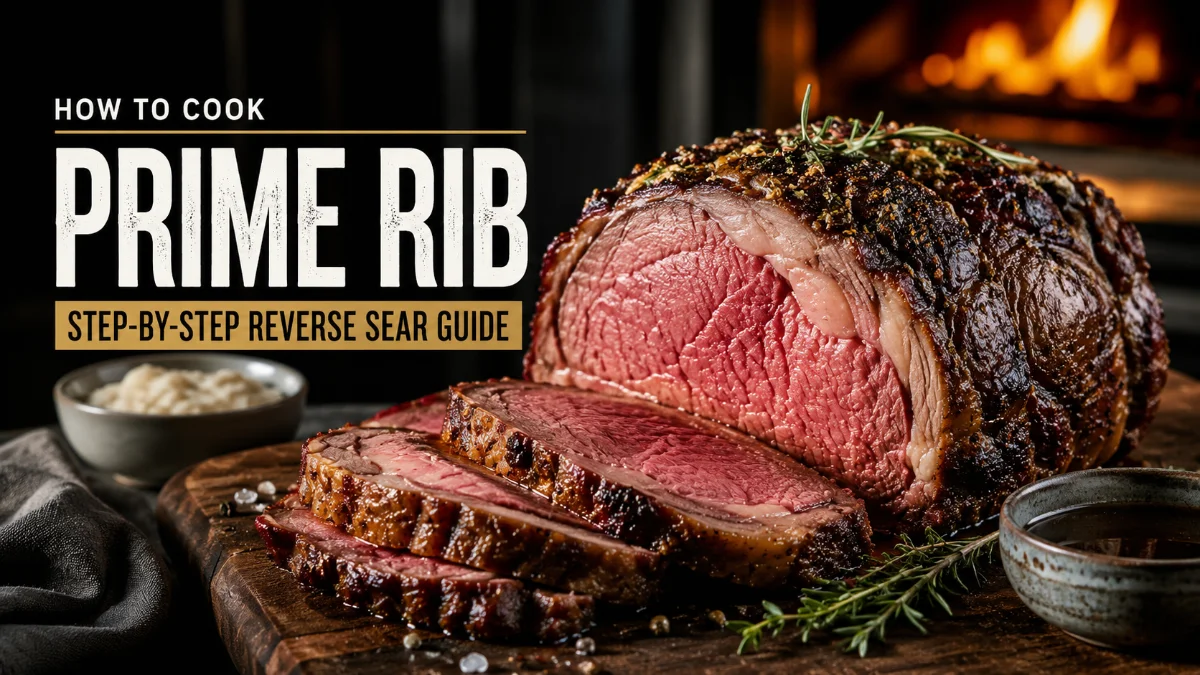
The fastest way to answer how to cook prime rib is this: season the roast well ahead of time, roast it slowly at a low oven temperature, finish it with a short blast of high heat, and pull it based on a thermometer reading rather than a clock. Follow this method, and you’ll get a roast with an evenly pink, tender interior edge-to-edge and a deep, savory crust, with no guesswork required. This guide walks through the full process of how to cook prime rib, from choosing the right roast to carving the finished result, so you can approach it with confidence.
What Is Prime Rib?
Prime rib, also called a standing rib roast, comes from the rib primal section of the cow and includes several rib bones with a thick cap of fat running along the top. It’s prized for heavy marbling, which is what makes it so tender and flavorful when roasted whole rather than cut into individual steaks. Understanding this cut is the first real step in learning how to cook prime rib well, since its size and fat structure shape almost every decision that follows.
Bone-In vs. Boneless
A bone-in roast keeps the rib bones attached, which insulate the meat during cooking, add flavor, and typically cost less per pound than boneless cuts. A boneless roast, sometimes labeled a ribeye roast, is easier to carve, feeds slightly more people per pound since there’s no bone weight, and cooks a bit faster. Either version works well with the method below; a bone-in roast usually needs a few extra minutes per pound because of that insulating bone.
What You’ll Need Before You Start
Getting the right equipment and roast size in place before you start prevents most of the common mistakes people run into on cooking day.
Choosing the Right Size Roast
Plan for roughly one pound of bone-in prime rib per person, or slightly less for boneless, since there’s no bone weight to account for. A roast in the 4- to 8-pound range works for smaller gatherings, while larger holiday tables often call for 8 to 12 pounds or more.
Essential Equipment
A reliable instant-read or leave-in meat thermometer is the single most important tool for cooking prime rib correctly. Visual cues and timing charts alone can easily lead to an overcooked roast, so if there’s one piece of equipment worth buying before you attempt to cook prime rib for the first time, it’s this. You’ll also want a roasting pan with a rack, kitchen twine if the roast needs tying, and a sharp carving knife for the final step.
Season the Roast in Advance (Dry Brining)
Salting the roast well before cooking, a technique known as dry brining, draws moisture to the surface that then reabsorbs along with the salt, seasoning the meat deeply and helping form a better crust. Coat the roast generously with kosher salt and any dried herbs or garlic you like, then set it uncovered on a rack in the refrigerator.
Timing: Same Day vs. 24–48 Hours Ahead
Salting 45 minutes ahead is better than nothing. But for the best results, season it 24 to 48 hours in advance. That extra time lets salt penetrate deeper and dries the surface slightly, which helps the crust brown more effectively during the final sear.
How to Cook Prime Rib: Step-by-Step Method
The most reliable method for cooking prime rib is reverse searing: roast it slowly at a low oven temperature until it’s nearly at your target doneness, then finish with a short blast of high heat to build a flavorful crust. This gives you an evenly cooked interior from edge to edge, without the thick gray band of overdone meat you’ll often see just beneath the crust when a roast is cooked hot the whole way through. Here’s the process broken into four steps.
- Bring to room temperature. Take the roast out of the refrigerator 1 to 2 hours before cooking so it loses some of its chill. A roast that goes into the oven cold cooks unevenly, with the exterior finishing well before the center catches up.
- Start the low-temperature roast. Preheat the oven to between 200°F and 250°F and set the roast fat-side up on a rack in a roasting pan. Cooking this slowly is central to how to cook prime rib without drying it out, since a gentle oven gives the center time to warm through evenly instead of racing ahead of the outer layers.
- Track the internal temperature. Insert an instant-read thermometer into the thickest part of the roast, avoiding the bone, and start checking once you’re within range for your roast’s size. This single check matters more than any other step in how to cook prime rib correctly, because pulling at the right moment is what separates rare from medium-rare from further along.
- Finish with a high-heat sear. Once the roast reads about 10 to 15 degrees below your final target, pull it and let the oven climb to 450°F to 500°F. Return the roast to the oven for 10 to 15 minutes just to brown the surface, then move it straight to resting. This final sear is what builds the deep crust that a low-and-slow roast alone can’t produce on its own.
Prime Rib Doneness Temperature Chart
Because the internal temperature keeps climbing after the roast leaves the heat, a process called carryover cooking, the pull temperature always needs to sit below the final temperature you actually want on the plate. That relationship is the whole logic behind the chart below.
| Doneness | Pull Temperature | Final Temperature (After Resting) |
| Rare | 110–115°F | 120–129°F |
| Medium-rare | 120–125°F | 130–134°F |
| Medium | 125–130°F | 135–144°F |
| Medium-well | 135–140°F | 145–154°F |
| Well-done | 145–150°F | 155–164°F |
These ranges are general guidelines, and you’ll see slight variation between sources. When in doubt, pull a touch early and let resting close the gap.
Why Resting Matters (Carryover Cooking Explained)
Resting isn’t optional in how to cook prime rib properly. It’s the step that lets carryover cooking finish and lets juices redistribute evenly through the meat instead of pooling out the moment you slice into it. Tent the roast loosely with foil and rest it for 20 to 30 minutes if it’s mid-sized, stretching closer to 40 minutes for a very large one. Skip this, and you’ll watch flavorful juice run straight onto the cutting board instead of staying in the meat.
How to Carve Prime Rib
Once rested, stand the roast on its base and cut along the bones first if it’s bone-in, separating the meat from the rack in one piece. Slice against the grain into portions about half an inch thick; this shortens the muscle fibers in each bite, which is exactly what makes a well-carved prime rib feel noticeably more tender than one sliced carelessly.
Alternative Method: Traditional High-Heat Roasting
Some cooks skip the low-and-slow phase entirely and roast at a consistent high heat throughout, often starting around 450°F to 500°F before dropping to a moderate temperature for the rest of the cook. It’s a faster route to a finished roast, but it carries a real trade-off: more uneven cooking and a thicker overcooked band near the surface compared with the reverse sear approach above. If you’re weighing different approaches to how to cook prime rib, this one suits cooks prioritizing speed over edge-to-edge evenness.
The same logic extends outdoors. A prime rib can be finished on a grill set up for indirect heat, following the identical low-temperature-then-sear sequence and checking internal temperature the same way throughout. Whichever heat source you choose, the core principles behind how to cook prime rib stay the same: thermometer-based doneness and a proper rest matter more than the equipment itself.
Common Mistakes to Avoid
Most prime rib disasters trace back to a handful of avoidable errors rather than any real complexity in the process.
- Skipping the meat thermometer and relying only on time estimates, which shift with oven accuracy and roast shape
- Seasoning too close to cooking time, leaving a bland interior despite a well-seasoned surface
- Pulling the roast at your final target temperature instead of accounting for carryover cooking
- Slicing immediately after cooking instead of resting, causing juices to run out onto the board
- Choosing a roast size that’s mismatched to your group without adjusting cooking-time expectations
What to Serve With Prime Rib
Round out the meal with au jus made from the pan drippings and a sharp horseradish sauce to cut through the richness, alongside simple roasted vegetables or mashed potatoes. These pairings are traditional for a reason: they balance the fattiness of the roast without competing with it.
Frequently Asked Questions
Pull the roast around 120–125°F and let it rest; carryover cooking brings it up to the ideal medium-rare range of about 130–134°F.
At a low oven temperature, expect roughly 15 to 20 minutes per pound, though actual time depends heavily on your oven and the roast’s exact shape, which is why a thermometer matters more than a fixed time estimate.
Searing after the low-temperature phase, known as reverse searing, produces more even cooking than searing first, since it builds the crust without overcooking the exterior meat.
Bone-in roasts offer slightly more insulation and flavor during cooking, while boneless roasts are easier to carve and feed a bit more per pound; both work well with the same cooking method.
Rest a mid-sized roast for about 20 to 30 minutes, extending to closer to 40 minutes for very large roasts, to let carryover cooking and juice redistribution finish.
A thermometer is strongly recommended given the cost of the cut and the difficulty of judging doneness by touch or time alone, so it’s worth buying an inexpensive instant-read model before attempting this roast.
Yes, a traditional high-heat method works and cooks faster, but it typically produces a thicker overcooked band near the surface compared with the reverse sear approach.
Pull temperature is where you remove the roast from heat, while final temperature is what it reaches after resting due to carryover cooking, typically 5 to 10 degrees higher.
Yes, using indirect heat and the same low-temperature-then-sear approach, checking internal temperature the same way as in an oven.