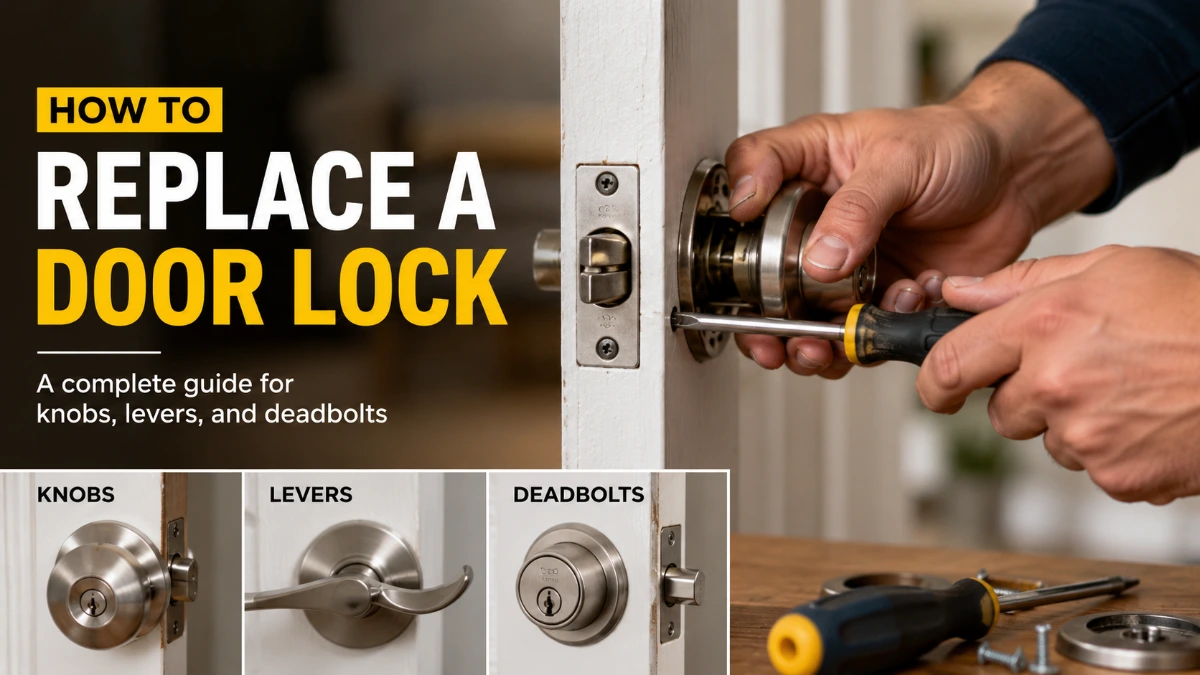
Learning how to replace a door lock usually takes 20 to 40 minutes with just a screwdriver, provided the new lock matches your door’s existing backset and bore hole diameter. The exact steps shift slightly depending on whether you’re working with a doorknob, a lever handle, a deadbolt, or an older mortise lock, and getting the strike plate aligned correctly is what usually determines whether the door closes smoothly afterward.
What You’ll Need Before You Start
Gather a Phillips and flathead screwdriver, a tape measure, a pencil, and a chisel in case a strike plate needs adjusting. Most residential locksets install with just a screwdriver, since knob, lever, and deadbolt hardware is designed for tool-free assembly once the door itself is already prepped.
Buy the replacement lock before removing the old one. Matching the backset ahead of time is the single most effective way to make sure that replacing a door lock stays a one-trip job rather than a second hardware-store run.
Measure Your Door First
Two measurements determine whether a new lock fits without modification: the backset and the bore hole diameter. Most U.S. residential doors use either a 2-3/8 inch or 2-3/4 inch backset, and most modern locksets ship with an adjustable latch that accommodates both sizes, which is why current hardware is more forgiving than older fixed-backset models.
Measure from the door’s edge to the center of the existing bore hole to find your backset, and measure the hole itself — commonly around 2-1/8 inches for standard knobs and deadbolts — to confirm bore compatibility. If either measurement doesn’t match the new lock’s specifications, a hole saw and door-prep kit will be needed instead of a direct swap, a detail that’s easy to overlook when shopping by price alone.
Removing the Old Hardware
- Locate the two small screws on the interior side of the knob, lever, or deadbolt plate and remove them with a screwdriver.
- Pull the interior and exterior halves apart; older units may need a small release tab or retaining clip depressed first.
- Remove the latch or bolt mechanism by unscrewing its faceplate on the door edge, then slide it out.
- Unscrew the strike plate from the door frame if it’s being replaced too.
Mortise locks — common in older or higher-end doors — differ from this process because the entire lock body sits inside a pocket cut into the door edge, secured through the door face rather than assembled through a simple bore hole. Removing one typically requires taking off the interior and exterior trim plates before the lock body will slide free, which is why mortise replacement generally takes longer than a standard knob or deadbolt swap.
Installing the New Lock
Insert the new latch or bolt assembly into the existing bore hole and secure its faceplate, making sure the beveled edge of the latch faces the direction the door closes. Feed the connecting screws or spindle through from one side, attach the opposite half, and tighten evenly so the mechanism isn’t pulled crooked.
For a deadbolt, this step also involves aligning the tailpiece with the interior thumb-turn — a detail that doesn’t apply to knob or lever installs. This alignment is part of how to replace a door lock with a deadbolt that trips up most first-time DIYers, since a misaligned tailpiece is a common reason the bolt won’t fully retract afterward.
Installing or Adjusting the Strike Plate
Screw the strike plate into the door frame so its opening lines up with the latch or bolt when the door closes. If the door won’t latch cleanly or the bolt binds, the plate usually needs a small shift, or the mortise pocket behind it needs to be deepened slightly with a chisel — a finishing step that’s easy to underestimate on doors that have settled or shifted over time. Getting this step right is often the difference between a lock that feels solid and one that needs repeated adjustment.
Testing and Troubleshooting
Close the door and operate the lock from both sides several times before calling the job finished. If the latch doesn’t catch or a deadbolt feels stiff, work through it methodically rather than forcing the mechanism, which risks damaging the cylinder.
| Symptom | Likely Cause | Fix |
| Door won’t latch | Strike plate misaligned | Loosen screws, shift plate slightly, retest |
| Deadbolt feels stiff or won’t retract | Tailpiece misaligned with thumb-turn | Reopen interior plate, reseat tailpiece |
| Bolt doesn’t reach frame fully | Strike plate mortise too shallow | Deepen mortise slightly with a chisel |
| Screws won’t tighten (stripped) | Worn or oversized screw holes | Use longer screws, or fill pilot holes with wood filler and redrill |
Knob vs. Lever vs. Deadbolt vs. Mortise
| Lock Type | Installation Complexity | Distinguishing Step |
| Doorknob | Low | Spindle alignment through the bore hole |
| Lever handle | Low | Same as knob; heavier mechanism needs even screw torque |
| Deadbolt | Medium | Tailpiece-to-thumb-turn alignment |
| Mortise lock | High | Entire lock body removed and installed as one unit from a door-edge pocket |
Rekeying vs. Replacing
If the existing lock still functions well and only the keys need to change, rekeying — swapping the internal pin configuration — is faster and cheaper than a full swap. Standard pin-tumbler cylinders typically require a locksmith or a rekey-specific tool kit, while some newer designs (such as SmartKey-style mechanisms) are built for tool-free, at-home rekeying by the owner.
Knowing how to replace a door lock is still worth learning even if rekeying handles your immediate need, since a worn spring, damaged cylinder, or bent tailpiece can’t be fixed through rekeying alone.
When to Call a Locksmith Instead
Stripped screws that won’t back out, a lock body frozen from corrosion, or security-rated commercial-grade hardware are situations where continuing DIY work risks damaging the door or lock beyond an easy fix. A locksmith is also the safer call for fire-rated doors in multi-unit buildings, since these often carry code requirements around approved hardware.
Smart locks fall into a separate category from the mechanical locks covered here, since they add battery compartments, app-pairing electronics, and sometimes wiring to a doorbell or hub system — replacing one is closer to a small electronics install than a standard hardware swap, and manufacturer instructions should take priority over general DIY guidance in that case.
Frequently Asked Questions
Most single-lock replacements — knob, lever, or deadbolt — take 20 to 40 minutes once the backset and bore diameter are confirmed to match, assuming no drilling is needed.
Not if the new lock matches the existing backset and bore hole diameter; most modern locksets include an adjustable latch specifically to avoid this.
Yes. Deadbolts and doorknobs use independent mechanisms with separate boreholes, so either one can be replaced without touching the other.
Rekeying changes the internal pins so old keys stop working, while replacing swaps the entire lock body. Replacement is necessary when the mechanism itself is damaged, or a different lock style is wanted.
This is almost always a strike plate alignment issue. The plate on the door frame needs to line up precisely with the latch or bolt, and even a small gap can prevent the door from closing securely.
Yes, though it’s the most involved of the four lock types covered here, since the entire lock body sits in a pocket cut into the door edge, if the replacement isn’t an exact size match, the pocket may need modification.
A Phillips or flathead screwdriver covers most installs. A chisel is only needed for strike plate adjustments, and a hole saw is only needed if the new lock’s bore size doesn’t match the old one.
No. Smart locks involve battery compartments and app-pairing electronics that standard mechanical locks don’t have, so manufacturer-specific instructions should be followed instead of the general steps above.