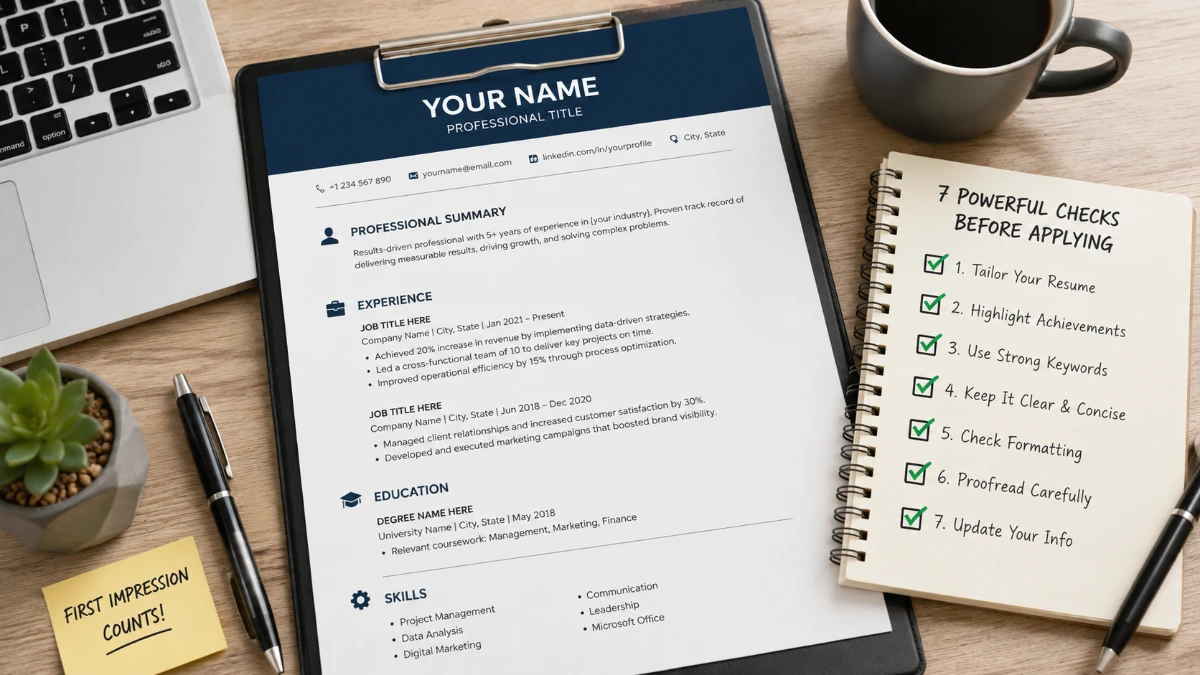
A standout resume makes it easy to verify your fit for a particular job. It should show relevant evidence, use clear language, and avoid distractions that hide your most useful qualifications.
The 7-check method
Use this sequence before you send an application:
- Identify what the employer must see
- Match each requirement to truthful evidence
- Turn duties into persuasive proof
- Give the best proof priority
- Make skills credible in context
- Remove formatting obstacles
- Verify every detail before submission
This approach to how to make a resume stand out is more reliable than adding decorative elements or expanding a skills list. It focuses the document on the employer’s decision: whether your background supports the role’s essential work.
Check 1: Is the target job clear?
A resume should not force the reader to guess what job you want or why your experience is relevant. Start by examining the job description and marking:
| Type of requirement | Typical signals | What your resume needs |
| Essential | “Required,” licence or qualification, a core platform, repeated responsibility | Visible, accurate proof near the beginning |
| Important | Preferred experience, recurring capability, industry knowledge | A supporting bullet, project, or skills entry |
| Secondary | General culture statements or minor preferences | Include only if it genuinely clarifies fit |
This is the first practical step in how to make a resume stand out. It prevents an unfocused document that gives equal space to everything you have ever done.
Write a quick matching note before revising:
| Employer asks for | You can demonstrate it through | Resume location |
| Project coordination | Maintained a launch plan for a six-person team | Experience |
| Data reporting | Created a weekly Excel tracker | Experience and skills |
| Client communication | Delivered progress updates for 20 accounts | Experience |
| Relevant training | Completed an analytics course | Education or certifications |
Use job-post language only when it accurately describes your experience, education, training, or projects. Tailoring means making relevant evidence easier to find—not claiming qualifications you do not possess.
Check 2: Does each requirement have proof?
The best way to understand how to make a resume stand out is to distinguish a claim from evidence. “Organised,” “hardworking,” “excellent communicator,” and “team player” are claims. A short, specific example is evidence.
For each essential or important requirement, find one bullet that demonstrates it. Use this pattern:
Action + work completed + context or scope + result, deliverable, or contribution
| Broad claim | Evidence-led alternative |
| Strong communicator | Prepared weekly project updates and incorporated stakeholder feedback into launch plans |
| Good with Excel | Built an Excel tracker that consolidated weekly activity data for team reporting |
| Team player | Coordinated a launch schedule with a six-person team and kept task owners updated |
A result is not limited to revenue or percentage growth. It can be a report that informed managers, a documented process, a completed deliverable, an improved workflow, a resolved problem, or a group you trained. If a number helps explain scale, use it accurately; do not invent metrics.
Berkeley Career Engagement advises applicants to focus on outcomes, quantify results where possible, and target accomplishments to employer needs.
Check 3: Are your bullets doing useful work?
Many resumes lose impact because their bullets repeat the job description. Instead of recording every duty, show the work that demonstrates the skills and judgement the next employer needs.
When applying how to make a resume stand out, begin with specific action verbs, such as analysed, coordinated, created, improved, resolved, trained, delivered, or redesigned. Then remove filler phrases like “responsible for” and “helped with” unless they add necessary context.
| Task description | Better resume bullet |
| Responsible for social media | Planned and scheduled campaign content across three channels, supporting event-registration activity |
| Answered customer questions | Resolved customer queries through email and chat while documenting recurring issues for follow-up |
| Helped with reports | Produced a weekly performance report that consolidated campaign activity for managers |
Do not force every line into the same formula. A good bullet can show scale, process, technical skill, decision-making, or an outcome; it only needs to be specific enough to make your contribution credible.
Check 4: Is the strongest material easy to find?
The document should have a clear reading order. Put what matters most for this vacancy before less relevant history.
A standard structure often works:
- Name and contact details
- Optional targeted headline or summary
- Job-relevant skills
- Experience, projects, research, internships, or volunteering
- Education, certifications, and additional relevant information
A summary earns its space only when it gives context that the rest of the resume cannot quickly provide—for example, a defined specialty, seniority level, or career change. Generic labels like “results-driven professional” do not help without supporting detail.
Texas State Career Services advises putting the information most important to the targeted employer near the top and less important material lower on the page.
Check 5: Do your skills have context?
A skills section should help an employer scan tools and capabilities, but it should not carry the entire argument. If a job asks for Excel reporting, customer support, research, project coordination, or stakeholder communication, show where you used it.
A practical layout might be:
Tools: Excel, Google Sheets, Salesforce, Tableau
Operations: Scheduling, process documentation, project updates
Languages: English, Hindi
Pair key skills with an experience or project bullet when possible. Repeating a word from the vacancy without evidence can look like keyword stuffing rather than qualification.
Grinnell College’s career guidance recommends conventional headings and cautions applicants against overloading their resumes with job-description keywords.
Check 6: Can the document be read after upload?
Clarity is both a writing and a formatting issue. For most standard online applications, use familiar headings, one readable font, consistent date style, short bullets, and sufficient white space.
Use restraint with tables, text boxes, icons, charts, photographs, images, graphics, and multi-column layouts. These can make content harder to review or may not transfer cleanly when a portal extracts text.
For how to make a resume stand out in an online system, follow the vacancy’s stated file-format requirement. If the portal creates a profile from your resume or shows a parsed preview, inspect it carefully before submitting. Check that headings, employers, dates, job titles, and bullets appear correctly.
If the posting does not state a preferred file type, keep a simple PDF and an editable DOCX version available. Submission systems and employer processes differ, so no single file type is best in every situation.
Candidates in visual fields can use a portfolio to demonstrate design or creative work. Unless the employer asks for a design-led resume, retain a clear text-first version for standard application portals.
Check 7: Is every detail defensible?
The final review is where a credible resume separates itself from a rushed one. Confirm that every element is truthful, relevant, and consistent.
Before applying, check:
- Job title, employer name, dates, qualifications, and certifications are accurate
- Numbers and percentages can be explained if questioned
- Verb tense is consistent: present for current work and past tense for previous roles
- Essential requirements have relevant evidence
- Headings are familiar and the document is easy to scan
- Unrelated roles, skills, and old details have been reduced or removed
- Contact details are current and professional
- Portfolio, LinkedIn, and work-sample links open correctly
- The file follows the employer’s instructions
- Another careful reader has reviewed the content and formatting
Texas State Career Services recommends a second opinion because a reviewer can identify unclear wording and formatting problems the writer may miss.
Evidence beyond full-time work
A resume can use more than formal employment to prove capability. This matters especially for students, new graduates, career changers, freelancers, and applicants returning to work.
Relevant evidence can include:
- Coursework and academic projects
- Internships and work placements
- Research or publications
- Volunteer roles and community leadership
- Freelance assignments
- Student organisations
- Certifications and professional training
- A portfolio of job-relevant work samples
Choose only material that helps an employer assess the target role. Texas State’s portfolio guidance recommends selecting and tailoring work samples to the position, using clear labels and concrete proof of skills.
FAQs
How long should my resume be?
There is no single correct length. A concise one-page resume can suit many students and early-career applicants, while applicants with substantial relevant experience may require more space. Prioritise relevance and readability, and follow any employer instruction.
How often should I customise a resume?
Tailor it for every meaningful application. You may not need to rewrite every sentence, but you should reprioritise experience, align truthful terminology, and remove material that does not support the vacancy.
Is an ATS-friendly resume guaranteed to pass screening?
No. Employers use different systems and hiring processes, and no format guarantees an interview or advancement. Use clear formatting, standard headings, truthful role-relevant language, and the requested file format.
Should I include a profile summary?
Only if it adds useful context immediately, such as a career transition, specialist focus, or level of experience. Skip it when it replaces stronger evidence with generic claims.
What if I do not have results with numbers?
Use specific non-numerical evidence: a deliverable completed, process documented, problem resolved, audience supported, decision informed, or training provided. Accuracy is more persuasive than an invented metric.
Is a resume template a good idea?
A simple template can help if it is readable and leaves enough space for targeted experience. Avoid layouts that depend on decorative graphics, dense columns, or complex elements for conventional online applications.
Should I add a photo?
Follow local employment norms and the employer’s instructions. Do not add one only for decoration when the space could better show relevant evidence.
When does a portfolio link help?
Use one if it gives direct access to polished work that demonstrates a required or relevant skill. Curate it for the role, label work samples clearly, ensure links work, and remove outdated or unfinished material.