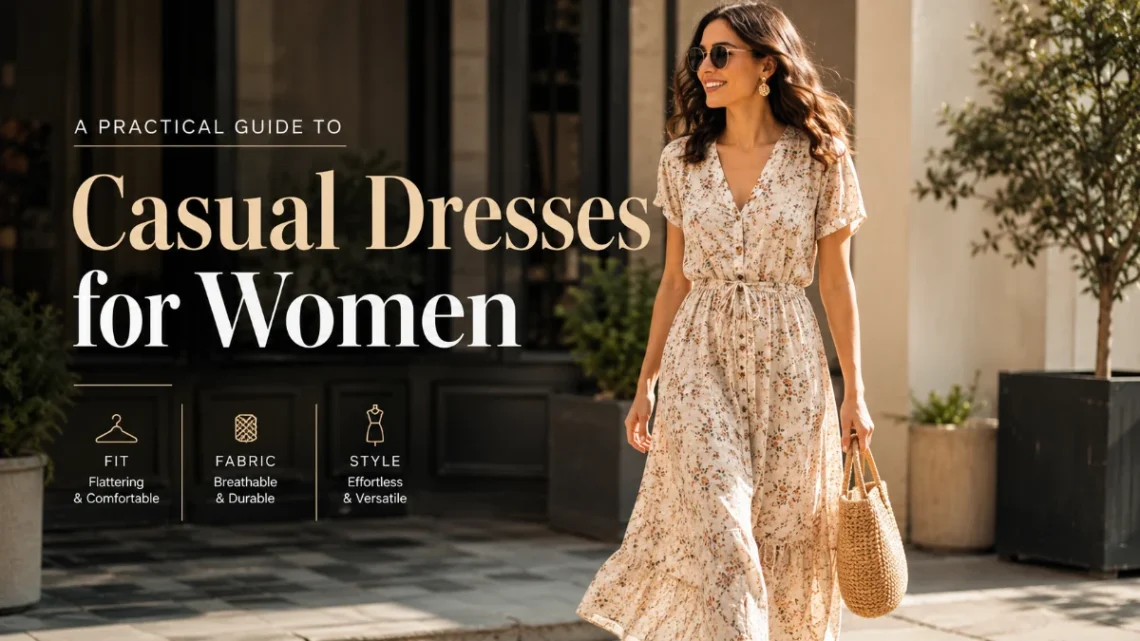
Choosing well among casual dresses for women starts with four quick decisions: where you’ll wear it, how much structure you want, which fabric suits your climate, and whether the fit holds up through a full day of movement. Answer those first, and narrowing a large online collection becomes far easier than scrolling through every option.
Most everyday collections group casual dresses for women by a handful of recurring shapes and lengths — T-shirt, shirt, wrap, and tiered silhouettes in mini, midi, or maxi lengths. Knowing what each shape solves lets you filter with purpose instead of guessing.
Match the Silhouette to the Job
Every silhouette solves a slightly different problem, so the fastest way to shop for casual dresses for women is to decide what job you need the dress to do before you open a filter menu.
- T-shirt dress: Best for low-fuss comfort. Check knit weight, neckline, and hem movement, since thinner knits can cling or show more than expected.
- Shirt dress: Best for a slightly neater everyday look. Check button spacing and belt placement, since gaping at the bust is a common fit issue.
- Wrap dress: Best for an adjustable waist. Check the tie closure and skirt overlap while moving, not just standing still.
- Fit-and-flare dress: Best for a defined waist with room through the skirt. Check how the bodice feels when seated, not only when standing.
- Tiered dress: Best for airy movement. Check opacity and lining, since layered fabric can still be sheer in bright light.
A simple test works better than a style label alone: can you wear it with shoes you already own, add one layer without bunching, and sit or walk comfortably? If the answer is no, the dress may end up worn once rather than often.
Choose a Length That Fits Your Day
Length changes more than the silhouette — it affects coverage, footwear pairing, and how easily the dress layers with a jacket or cardigan. Mini, midi, and maxi are the most common length filters, but exact hem placement varies by brand and by height.
Midi lengths tend to offer the most flexibility for casual dresses for women, since they pair with trainers, flats, sandals, or boots and move easily through errands, work, and weekend plans. Mini lengths suit warm-weather ease but should be checked for how the hem behaves when sitting or walking quickly. Maxi lengths add coverage and a one-piece outfit, but only if the hem clears the ground with the shoes you actually plan to wear.
Before checkout, compare the listed length against a dress already in your wardrobe. A product photo cannot show you where a hem lands on your specific height, so this comparison is more reliable than the image alone.
Read the Fabric Label Before the Description
Fabric composition tells you more about real-world comfort than a product photo does. Cotton, linen, jersey, and blended fabrics each behave differently once they’re washed, worn, and layered, and dimensional change after laundering depends on the fiber, the way it’s woven or knit, and how it’s finished and cared for — not on the fabric name alone.
That’s why the care label deserves attention before you add a dress to your basket, particularly if you plan to wear and wash it often. A breathable-sounding fabric can still need specific washing or drying steps to keep its shape, so treat “breathable” or “soft” as a starting point, not the full picture.
For casual dresses for women intended for regular rotation, three checks matter most: fabric composition and blend percentage, lining (or lack of it) for opacity and warmth, and the exact wash-and-dry instructions on the label. These three details predict comfort and upkeep far better than color or print.
Check Fit With a Movement Test, Not Just a Photo
Sizing differs between brands, so a size that fits one dress well may not fit the next identically. Use the retailer’s specific size chart and garment measurements first, then apply this quick check before finalizing your order:
- Shoulders and armholes — seams shouldn’t pull when you reach forward.
- Bust or closures — buttons should sit flat; wrap necklines should hold their coverage when you move.
- Waist placement — a seam or elastic waist should sit comfortably, not ride up or dig in.
- Hips and skirt — there should be enough ease to sit and walk without pulling.
- Hem behavior — check how it moves when seated or walking, not only when standing.
Comparing the seller’s measurements to a similar dress you already own and like is a useful estimation method, though it isn’t a guarantee — fabric stretch and cut still vary by brand. Prioritizing this movement-based check over a single styled photo is one of the more reliable ways to avoid a dress that looks right online but feels wrong in person.
Build Outfit Formulas Around the Dress
A dress earns more wear when you already have two or three ways to style it. Casual dresses for women become more versatile once you treat footwear, layering, and bag choice as adjustable variables rather than afterthoughts.
- Relaxed daytime: T-shirt or easy midi dress, trainers or flat sandals, crossbody bag, light overshirt — suited to errands, travel days, or casual meetups.
- Smart-casual: Shirt dress or structured midi, loafers or clean trainers, tote bag, cardigan or light jacket — suited to a relaxed office or daytime plans that need a touch more polish.
- Warm-weather: Breathable woven dress, flat sandals, sun protection accessories — suited to heat and humidity where airflow matters more than layering.
- Cooler weather: Midi dress, ankle boots or trainers, knitwear layer, jacket that allows the skirt to move — suited to transitional temperatures.
Styling can shift a dress’s formality within a reasonable range, but it can’t fully override the base garment. A very sheer, very short, or clearly occasion-focused dress may still look out of place in some settings, even with practical shoes and a blazer added. Starting with a dress that already suits your intended setting makes styling far easier than trying to correct the wrong base garment afterward.
Shop With a Faster, More Useful Filter Order
Online retailers organize casual dresses for women by style, length, and occasion, but filter options vary by seller. A practical shopping sequence cuts through that variation:
- Set the occasion: everyday, relaxed office, travel, or warm-weather wear.
- Choose length: mini, midi, or maxi.
- Pick a silhouette that matches the job you need it to do.
- Filter by fabric when climate or care matters most.
- Read composition, lining, and care instructions on the product page.
- Check multiple photo angles, including movement shots where available.
- Confirm current sizing, delivery, and return details before completing the purchase.
Treat detailed product information as decision evidence — composition, measurements, and care instructions matter more to long-term satisfaction than the styled hero photo.
Make Care Part of the Purchase Decision
Care requirements should factor into the buying decision itself, not just post-purchase laundry. A dress that needs handling you’re unlikely to follow — frequent hand-washing, delicate drying, or careful ironing — may end up unworn regardless of how it looks in photos.
Following the garment’s care label is the most reliable way to protect its fit and shape over time, since washing practices interact directly with the fabric’s construction. Matching care demands to your actual routine, rather than your ideal routine, makes casual dresses for women more likely to earn repeat wear rather than sit unused in the closet.
Frequently Asked Questions
Formality comes from a combination of fabric, cut, and styling — relaxed silhouettes, simple closures, and everyday fabrics like cotton or jersey typically read as casual, while structured fabrics and occasion-specific details read as dressier.
Midi lengths tend to offer the most flexibility across settings and footwear, though the right length ultimately depends on your height, activity level, and climate.
Yes, particularly shirt dresses or structured midi styles paired with clean footwear and a cardigan or blazer, though workplace dress codes vary and are worth checking directly.
Compare the brand’s specific measurements to a similar dress you already own, and check the fit against a movement-based checklist covering shoulders, waist, hips, and hem — this is a helpful estimate, not a guarantee.
Yes — fiber content, weave or knit type, lining, and finishing all influence breathability, drape, and how the fabric behaves after washing, which matters more for daily comfort than the fabric name alone.
Because washing and drying practices interact with the fabric’s construction to affect shape and fit over time, choosing a dress with care needs that match your actual routine helps it last longer in rotation.
They can be, but check the tie closure and skirt overlap while moving rather than only when standing, since coverage can shift throughout the day.

