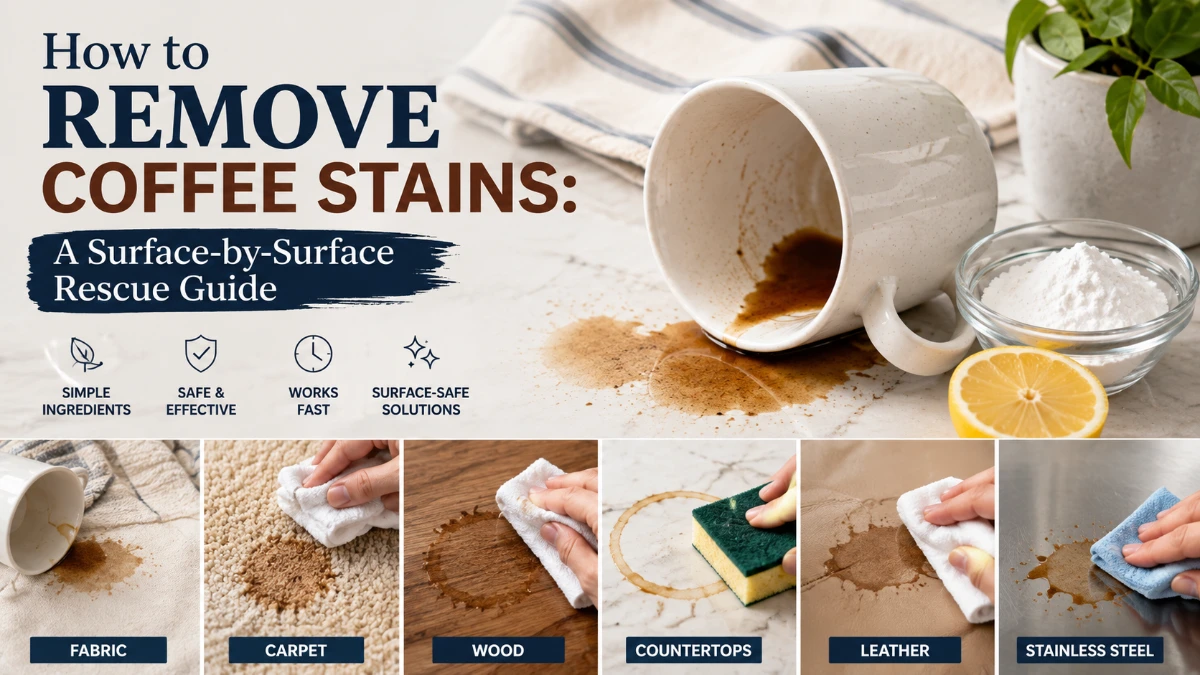
The best way to how to remove coffee stains is to treat the spill promptly, blot rather than rub, and select a method that suits the material. For washable fabric, start with cool water, pretreat with liquid detergent or a stain remover, wash as the care label allows, and inspect before drying.
First, decide what is stained
The right action changes with the surface. A garment can often be rinsed and laundered; a rug needs limited moisture and residue removal; upholstery may have a manufacturer-specific cleaning restriction.
| If coffee landed on… | Do this first | Do not do this |
| Washable clothing or linens | Blot, then sponge or soak in cool water | Put it in the dryer before checking the mark |
| Carpet or a rug | Blot with a clean, white absorbent cloth | Rub, flood the area, or pour solvent onto the carpet |
| Upholstery or a mattress | Blot immediately and find the care instructions | Saturate fabric, foam, or cushion filling |
| Mug, glass, stainless steel, or glazed ceramic | Wipe away the spill and wash with a nonabrasive cleaner | Scrub delicate coatings |
| Stone, finished wood, leather, silk, wool, or suede | Blot and use material-specific care guidance | Use an untested all-purpose remedy |
Acting quickly matters. The American Cleaning Institute advises treating stains as soon as possible, while the Carpet and Rug Institute notes that delaying can make a spill permanent
Clothes: rinse, pretreat, wash
For washable garments, how to remove coffee stains is usually a three-part process: cool-water treatment, pretreatment, and laundering.
- Sponge or soak the mark in cool water.
- Apply a prewash stain remover or liquid laundry detergent as directed.
- If needed, soak the garment in cool water for at least 30 minutes.
- Launder using the cycle and temperature allowed by its care label.
- Use oxygen bleach or chlorine bleach only when the item and product labels both say it is safe.
- Check the fabric before drying; if a mark remains, treat and wash it again.
The American Cleaning Institute specifically recommends cool water, pretreatment, and fabric-safe bleach where needed for coffee and tea stains. It also advises re-treating rather than drying items with a remaining stain
For delicate garments
Dry-clean-only, wool, silk, suede, leather, vintage, or valuable items are not good candidates for improvised stain-removal experiments. Blot the spill, retain the care information, and seek product-maker or professional-cleaner guidance.
Carpet: clean lightly, rinse thoroughly
A carpet stain needs less liquid than most people use. The goal is to move the coffee into an absorbent cloth without saturating the fibres or leaving cleaner behind.
- Press a dry white absorbent cloth or paper towel onto the spill; replace it as it becomes wet.
- Test a carpet spot-removal product in an unseen area for colour transfer or damage.
- Put a small amount of the approved solution on the cloth and work from the outside toward the centre.
- Dab gently; do not rub.
- Continue only while coffee transfers to the cloth.
- Rinse lightly, then blot repeatedly until the area is as dry as possible.
The Carpet and Rug Institute advises pretesting, limited use of solution, blotting instead of rubbing, and thorough rinsing. Residue can attract soil, so several light rinse-and-blot cycles may be necessary
Coffee with cream or sugar may need a repeat of the same careful routine rather than a stronger cleaner. That approach helps remove remaining residue without over-wetting the carpet.
Upholstery and mattresses: stop at the care label
When considering how to remove coffee stains from upholstery or a mattress, the safest general instruction is to blot immediately and check the manufacturer’s care label before using water or a cleaning product.
If the label specifies a permitted method, follow it exactly and use minimal moisture. Stop if dye transfers, the fabric changes texture, or the filling becomes wet. If the item has water-restricted instructions, is delicate, or has a large spill, contact its manufacturer or a qualified upholstery cleaner.
Smooth, washable surfaces
For coffee on a mug, glazed ceramic, glass, stainless steel, or another washable nonporous surface, wipe it up promptly. Then use a suitable nonabrasive cleaner, rinse the surface, and dry it with a soft cloth.
The American Cleaning Institute’s hard-surface advice supports checking care directions and avoiding abrasive methods on susceptible finishes. For natural stone, finished wood, leather, and unknown coatings, stop after blotting and use the manufacturer-approved method rather than applying a generic household cleaner
Old or dried marks
A dried coffee mark does not automatically require a harsher product. Rehydrate it only in a manner appropriate to its material, then repeat the relevant method: cool-water pretreatment and laundering for washable fabric, or limited spot treatment and blotting for carpet.
To how to remove coffee stains after the spill has dried, start conservatively. On fabrics, use cool water as the first step; on carpets, test the cleaner and avoid soaking. Repeat the matched method before considering a stronger product.
Avoid these preventable errors
- Rub the mark instead of blotting it.
- Apply heat to washable fabric before confirming the stain is gone.
- Use bleach without confirming fabric and product compatibility.
- Treat upholstery as though it were carpet.
- Leave detergent or spot-treatment residue in carpet fibres.
- Mix cleaning products.
Bleach must never be mixed with ammonia or acid-containing cleaners. Poison Control says bleach plus ammonia can create chloramine gas, while bleach plus acid can form chlorine gas.
If you accidentally create fumes, leave the area immediately, get fresh air, and ventilate the space if it is safe to do so. Seek medical attention for breathing trouble or other serious symptoms; in the United States, Poison Control is available at 1-800-222-1222
When a professional is the better option
Choose professional help when a careful, material-appropriate attempt has not worked, the item is valuable or delicate, or its care directions rule out the treatment you would otherwise try.
A professional cleaner is particularly sensible for:
- Dry-clean-only clothing and valuable textiles
- Silk, wool, suede, leather, and antique pieces
- Large or stubborn carpet stains
- Colour transfer, fading, or texture changes after testing
- Upholstery or mattresses with restricted care instructions
The Carpet and Rug Institute recommends considering professional cleaning for stubborn carpet spills rather than continuing aggressive spot treatment
Frequently Asked Questions
Blotting the excess coffee immediately is the most useful first move. Follow it with the surface-specific treatment rather than rubbing or applying a generic cleaner.
Yes. The American Cleaning Institute recommends sponging or soaking coffee and tea stains in cool water before pretreatment and laundering
Often, but success depends on the material, stain age, prior heat exposure, and previous cleaning attempts. Start again with the safest material-specific method rather than immediately using a stronger product.
Only if both the fabric’s care label and the bleach label allow it. Use the bleach type that is safe for the specific fabric
Blot promptly, use a carpet-appropriate treatment sparingly, rinse thoroughly, and repeat the same method if needed. Carpet guidance for coffee with cream and sugar stresses residue removal and avoiding excessive solution strength
No. Cleaner compatibility depends on the surface and finish. Do not use vinegar on an unknown or sensitive material without confirmed care instructions, and never combine it with bleach
No. Check it first. The American Cleaning Institute advises re-treating and rewashing instead of drying when a stain remains
Leave the affected area and breathe fresh air. Poison Control advises medical attention for breathing difficulty or other serious symptoms; in the United States, call 1-800-222-1222 or use its online help tool