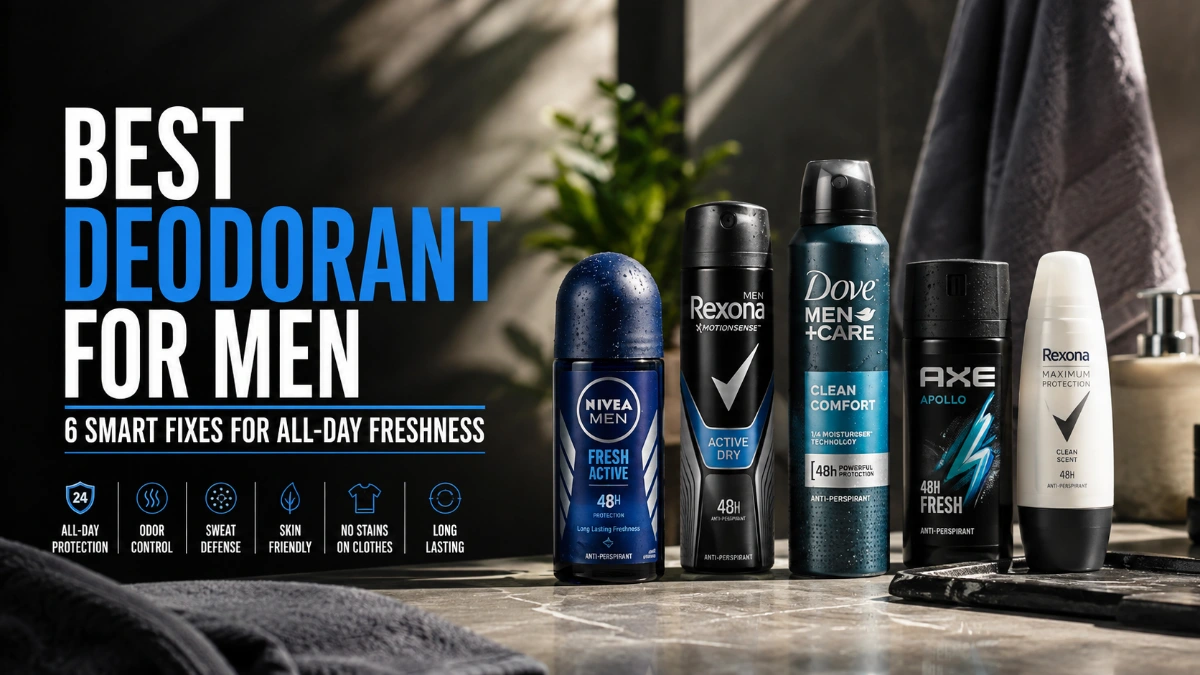
Most men picking the best deodorant for men focus entirely on the product and completely ignore timing — and timing is often the bigger factor. A premium antiperspirant applied at the wrong moment can underperform a cheap one applied correctly. Before comparing formulas, it’s worth understanding why so many “good” products still fail in practice.
The Timing Mistake Almost Everyone Makes
Nearly everyone applies deodorant or antiperspirant in the morning, right after a shower, then wonders why it wears off by the afternoon. Dermatologists consistently point to a simpler explanation: mornings are the worst time to apply an antiperspirant. Sweat glands are most active during the day, and applying the product to skin that’s about to sweat gives the aluminum-based compound almost no time to settle into the sweat duct before it’s washed out by fresh perspiration.
The fix is straightforward — apply antiperspirant at night, on clean, dry skin, before bed. Overnight, sweat gland activity drops, giving the active ingredient several uninterrupted hours to form its duct-blocking effect. This single change in routine often does more for all-day freshness than switching to a different best deodorant for men on the shelf.
Other Small Habits That Quietly Undermine Any Formula
Beyond timing, a handful of recurring application habits reduce effectiveness regardless of which product is used:
- Applying to damp or sweaty skin, which prevents the product from adhering properly and dilutes the active ingredient
- Over-applying, assuming more product means more protection — one or two swipes for sticks and roll-ons is enough; extra product raises irritation risk without improving results
- Applying immediately after shaving, when skin is more reactive to fragrance and alcohol content
- Layering a new application directly over yesterday’s residue instead of washing the area first
- Skipping antiperspirant on heavy-sweat days out of a false assumption that “it won’t work anyway” in hot weather
Fixing these habits often resolves complaints about a product “not working” long before switching brands does.
Deodorant or Antiperspirant — Which Fixes Your Actual Problem
Technique matters, but it can’t fix a category mismatch. Deodorant neutralizes odor by killing bacteria and masking scent with fragrance; it does nothing to reduce sweat. Antiperspirant contains aluminum-based compounds that physically plug the sweat duct, reducing perspiration itself. If your complaint is smell without visible sweating, deodorant alone usually solves it. If you deal with sweat stains or dampness, you need a product with an antiperspirant active ingredient — no amount of correct technique will make deodorant stop sweat it isn’t designed to stop.
Matching the Best Deodorant for Men to Your Actual Profile
| Category | What to look for | Why it matters |
| Heavy sweat | Antiperspirant with aluminum chlorohydrate or aluminum zirconium | Physically blocks sweat ducts; deodorant alone can’t do this |
| Sensitive skin | Baking-soda-free, fragrance-free or hypoallergenic formulas | Reduces risk of contact irritation from alkaline ingredients |
| Natural/aluminum-free preference | Odor-neutralizing acids (mandelic, citric) or probiotic formulas | Controls bacteria without blocking sweat glands |
| Budget-conscious | Drugstore antiperspirant-deodorant hybrids | Often comparable active-ingredient concentration to premium sticks |
Independent testing outlets don’t converge on one single “best overall” product — some favor aluminum-free acid-based sticks for odor control, others favor higher-concentration antiperspirants for heavy sweat. That disagreement itself is a signal: the best deodorant for men is the one matched to your specific sweat and skin profile, not necessarily whichever product tops a generic list. Brand-reported sweat-reduction figures — some claiming above 90% — come from manufacturer-run clinical testing rather than independent verification, so treat them as directional brand claims rather than confirmed universal results.
Is the Aluminum Actually Something to Worry About
Briefly, no — not based on current evidence. Major toxicology reviews and statements from the American Cancer Society have found no convincing link between aluminum-based antiperspirants and cancer, and dermal absorption of aluminum is minimal; newer research has actually revised absorption estimates even lower than older studies suggested. The one legitimate reason to skip aluminum isn’t a safety concern — it’s personal skin sensitivity, since some men do get irritation from aluminum salts or from baking-soda-based natural alternatives.
Format Follow-Through: Stick, Spray, Roll-On, Cream
Once timing and category are sorted, the format is mostly a comfort and lifestyle choice. Sticks give the most consistent, controlled dose of active ingredient. Sprays dry fast and avoid clothing stains but deliver less product per swipe. Roll-ons and creams apply with less friction, which tends to suit sensitive skin, and are worth considering for anyone active outdoors or reapplying frequently in hot climates.
Frequently Asked Questions
Applying antiperspirant in the morning instead of at night. Sweat gland activity is highest during the day, which reduces how well the active ingredient can settle into the sweat duct.
No. One or two swipes for sticks and roll-ons is enough; excess product doesn’t improve odor or sweat control and raises the chance of skin irritation.
No. Deodorant masks and neutralizes odor, while antiperspirant reduces sweat itself by blocking sweat ducts with aluminum-based compounds.
Major reviews have found no convincing link between aluminum-based antiperspirants and cancer, and skin absorption is minimal according to current research.
Baking-soda-free or fragrance-free formulas, often in roll-on or cream format, reduce irritation risk compared to alkaline stick antiperspirants.
It’s better to wait — freshly shaved skin is more reactive to fragrance and alcohol content, which can cause stinging or irritation.
Because sweat levels, skin sensitivity, and odor causes vary enough between men, category-matched picks are more reliable than a single universal winner.