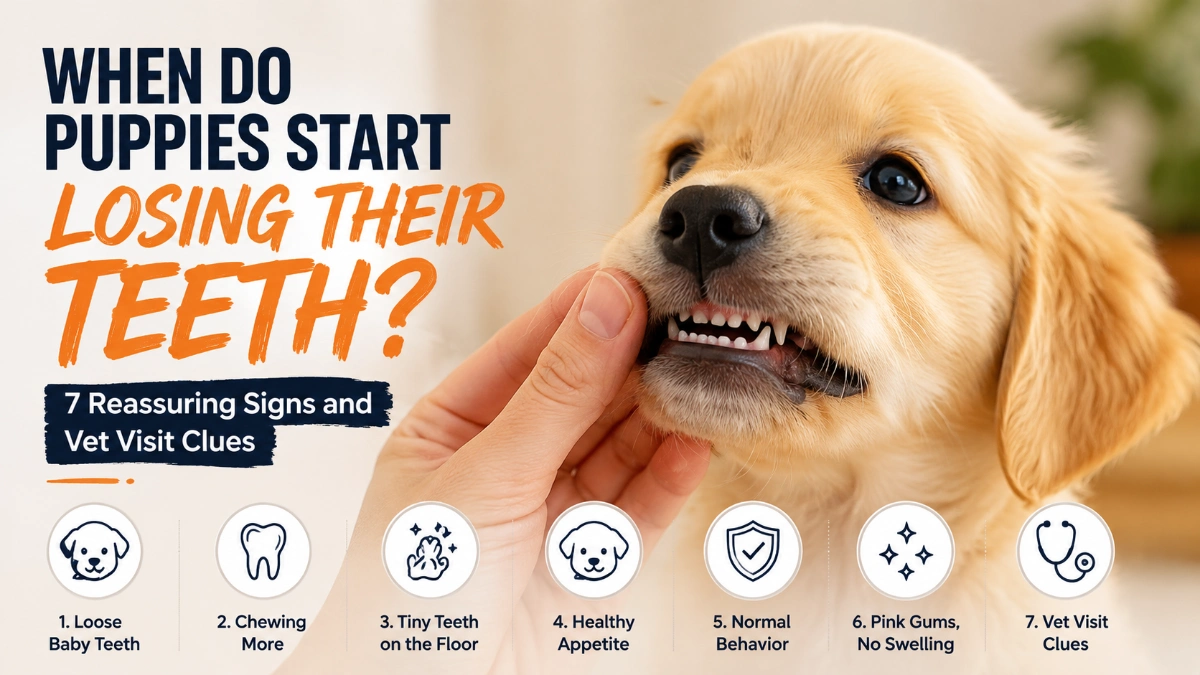
Puppies usually begin losing their baby teeth at around 12–14 weeks, or roughly three months old. The tooth-change period generally continues until about six months, while all permanent teeth are typically present by around seven months.
First, check what you see
When do puppies start losing their teeth? The first losses are often the small front incisors. In the weeks that follow, the canines and premolars are replaced, while adult molars emerge at the back of the mouth.
A puppy has 28 baby teeth and will normally develop 42 adult teeth. Adult molars do not replace baby molars; they erupt as new teeth, which is why the mouth can seem suddenly more crowded during this phase.
| What you notice | Usually expected | Arrange a vet check |
| A tiny front tooth is missing | Yes, particularly from about 12–14 weeks | If bleeding is persistent or substantial |
| More chewing and mouthing | Common during teething | If chewing seems painful or your puppy stops eating |
| A baby and adult tooth briefly appear together | Can occur during the changeover | If two teeth remain in the same spot |
| You do not find the shed tooth | Common; it may be swallowed unnoticed | If there is choking, repeated vomiting, or distress |
| Gums look mildly irritated | Can occur temporarily | If there is swelling, discharge, or a strong odour |
How the timeline unfolds
When do puppies start losing their teeth varies somewhat by individual development and by tooth type, so the ages below are a guide rather than a deadline.
| Age | Typical mouth changes |
| 3–5 weeks | Baby teeth begin erupting |
| About 6–8 weeks | The baby-tooth set is usually established |
| Around 12–14 weeks | Baby teeth begin shedding, commonly beginning with the front incisors |
| 4–6 months | Permanent incisors, canines, premolars, and newly erupting molars fill the mouth |
| Around 6 months | Many puppies have completed teething |
| By about 7 months | All permanent teeth are generally present |
A puppy may look “between stages” for several weeks. One area of the mouth may have adult teeth while another still has baby teeth, especially as the larger canines and premolars change.
Make chewing safer
When do puppies start losing their teeth? Chewing is a normal outlet, but the item matters. Choose puppy-appropriate chews that suit your dog’s size, supervise use, and discard anything that becomes sharp, splintered, or small enough to swallow.
Avoid exceptionally hard objects, including stones, antlers, hard bones, and rigid toys that do not yield at all. They can damage teeth, and broken or small fragments can also become choking or digestive hazards.
Use chewing as a training opportunity:
- Keep a few suitable toys available and rotate them.
- Redirect teeth on hands, sleeves, or furniture to a toy without rough play.
- Supervise new chew products until you know how your puppy uses them.
- Check toys frequently for wear, cracks, loose parts, and unsafe sizing.
- Never attempt to pull a loose baby tooth at home.
Recognize retained baby teeth
When do puppies start losing their teeth? An adult tooth should not have to share its place with the baby tooth it is replacing. If both remain together, the baby tooth is considered retained or persistent.
The most familiar example is a double canine: a narrow baby canine sitting next to the permanent canine. Retained teeth can force adult teeth into an abnormal position, create crowding, trap food, and contribute to an uneven bite or later gum disease.
Small breeds and short-nosed breeds have a higher likelihood of retained baby teeth, but this can happen in any puppy. If two teeth occupy the same location, schedule a veterinary appointment promptly rather than waiting for the baby tooth to fall out.
Know when care cannot wait
When puppies start losing their teeth is helpful background, but pain or an abnormal-looking mouth should take priority over an age-based timeline.
Contact a veterinarian promptly if your puppy has:
- A baby tooth beside an erupting adult tooth
- Persistent, heavy, or repeated bleeding
- Facial swelling, discharge, or a strong foul mouth odour
- Refusal to eat, yelping during chewing, or repeated pawing at the mouth
- A tooth pressing into the palate, gums, or another tooth
- Difficulty closing the mouth or an obviously uneven bite
- A crowded mouth or teeth that still appear incomplete at around seven months
A veterinarian can assess the bite, determine whether a retained tooth needs extraction, and decide whether dental imaging is necessary. Early assessment can help prevent adult teeth from remaining in an abnormal position.
Start a calm dental routine
When do puppies start losing their teeth? Brief and gentle mouth handling helps prepare them for routine dental care. Begin by touching the muzzle and lifting the lips, rewarding calm behaviour, and stopping if your puppy becomes distressed.
Once your puppy accepts handling, introduce a soft dog toothbrush or finger brush with toothpaste made for dogs. Do not use human toothpaste: dogs swallow toothpaste, and products designed for people are not formulated for that use.
Aim for short, positive sessions rather than a perfect clean. Gradual practice can make dental checks, brushing, and veterinary examinations less stressful as your puppy grows.
What not to do
When do puppies start losing their teeth? Avoid home remedies that create additional risks. Do not pull a tooth, force your puppy’s mouth open, or give objects so hard that they could fracture teeth.
Do not assume every double tooth will resolve naturally. If a permanent tooth is already present beside a baby tooth, veterinary evaluation is the safest next step.
Frequently Asked Questions
Most puppies begin losing baby teeth at around 12–14 weeks old. The small front incisors are often the first teeth to shed.
The main tooth-change period usually runs from roughly three to six months. Most dogs have all permanent teeth by about seven months.
Puppies often swallow a shed tooth while eating or playing, and owners may never notice it. Seek veterinary advice if your puppy has choking, repeated vomiting, or clear distress.
The baby canine may have remained while the permanent canine erupted. This can be a retained baby tooth and should be assessed by a veterinarian
No. Allow it to fall out naturally. If it is painful, broken, or remains beside an adult tooth, contact your veterinarian.
A small, short-lived amount of gum bleeding can occur during normal shedding. Persistent bleeding, swelling, discharge, or signs of pain need veterinary attention.
Choose puppy-appropriate chew toys that are the correct size and stay with your puppy while they use them. Remove toys that splinter, crack, or become small enough to swallow.
Start with gentle mouth handling and progress to a soft brush and dog toothpaste once your puppy is comfortable. Keep the sessions short and positive.
Book a veterinary oral examination, particularly if you can see a baby tooth next to a permanent tooth or the mouth seems crowded.