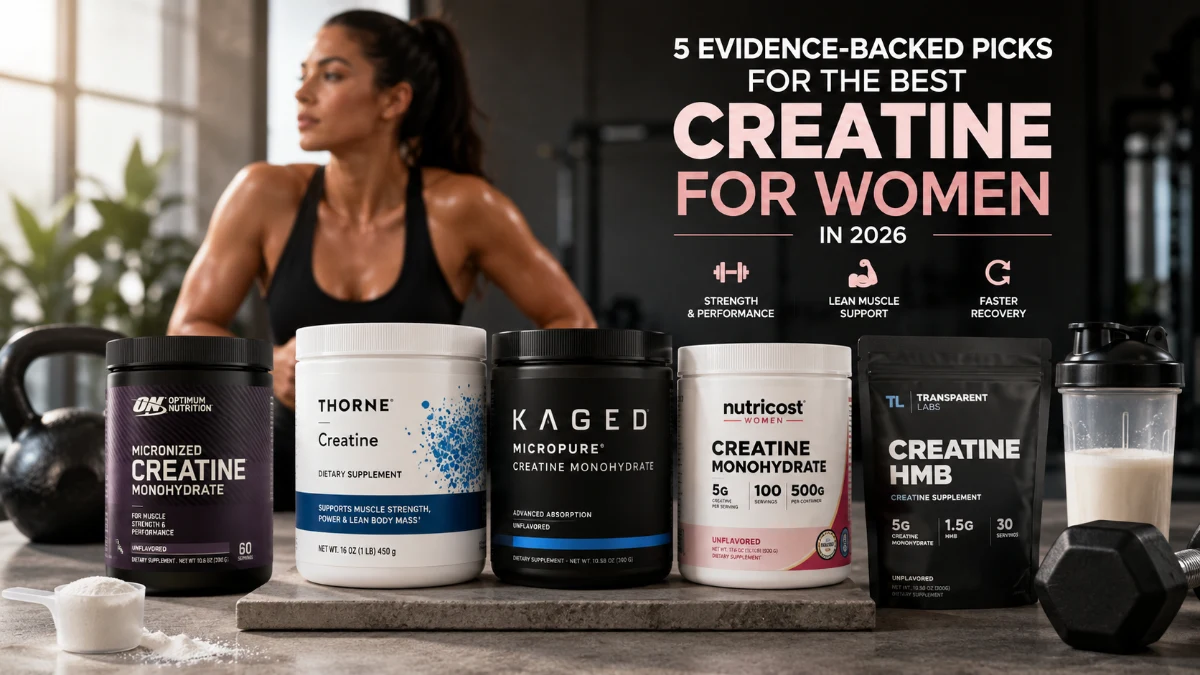
For most healthy adult women, the best creatine is plain creatine monohydrate, usually taken at 3–5 grams per day. A loading phase is optional rather than required. When choosing a product, prioritize a clearly disclosed dose, simple ingredients, and credible third-party testing. Current research supports creatine’s usefulness for strength and exercise performance, while female-specific research is increasingly examining muscle, aging, cognition, and reproductive health.
Best Creatine for Women at a Glance
| Product | Best for | Form | Creatine per serving | Third-party certification/testing | Key reason to consider |
| Thorne Creatine | Best overall | Powder | 5 g | NSF Certified for Sport | Simple formula, transparent dose, strong testing |
| Klean Athlete Klean Creatine | Best NSF-certified alternative | Powder | 5 g | NSF Certified for Sport | Single-ingredient formula and athlete-focused certification |
| Nutricost Creatine Monohydrate | Best budget option | Powder | 5 g | Third-party tested | Low cost with a straightforward monohydrate formula |
| Momentous Creatine | Best premium unflavored option | Powder | 5 g | NSF Certified for Sport | Single ingredient, unflavored, premium quality positioning |
| Optimum Nutrition Micronized Creatine Capsules | Best capsules | Capsules | 5 g daily serving | Informed Choice Certified | Convenient alternative to powder |
Product specifications, certifications, and serving information can change, so check the manufacturer’s current label before purchasing. Current independent comparisons also identify Thorne, Nutricost, Momentous, and Optimum Nutrition among leading options, with different strengths depending on price, format, and certification.
The Bottom Line: What Is the Best Creatine for Women?
For most healthy adult women, you do not need a women-specific creatine formula.
The most evidence-supported choice is creatine monohydrate. A daily dose of 3–5 grams is a practical maintenance range for most people, and taking it consistently matters more than taking it at a specific time of day. A loading phase can saturate muscle stores faster, but it is optional.
Our best overall pick is Thorne Creatine because it provides a simple 5-gram creatine monohydrate serving and carries NSF Certified for Sport certification. It is a particularly straightforward choice for women who want a single-ingredient product rather than a proprietary blend. Healthline also currently ranks Thorne as its top overall creatine for women.
That said, the “best” product depends on what matters most to you. A budget shopper may prefer Nutricost, someone who wants a premium unflavored powder may prefer Momentous, and anyone who dislikes powders may prefer creatine capsules.
More importantly, the supplement itself is only part of the decision. The research on creatine in women is growing, but female-specific evidence remains smaller and more mixed than the broader creatine literature. A 2025 systematic review of active females found benefits in some performance outcomes but also considerable variation among studies, so creatine should be presented as a well-supported option rather than a guaranteed performance enhancer for every woman.
Best Creatine for Women: Our 5 Picks
1. Thorne Creatine — Best Overall
Why we picked it: Simple formula, 5 grams of creatine monohydrate per serving, and NSF Certified for Sport.
Thorne Creatine is our best overall choice because it gets the fundamentals right without trying to turn creatine into a complicated supplement stack. The product contains creatine monohydrate as its active ingredient, provides a 5-gram serving, and is NSF Certified for Sport. Current product information also lists 90 servings per container.
For women who simply want a reliable daily creatine powder, that simplicity is an advantage. There is no need to pay for a long ingredient list when the evidence base is centered on creatine monohydrate itself.
The NSF Certified for Sport designation is particularly useful for competitive athletes because it provides an additional layer of independent testing for product contents and substances prohibited in sport. Certification does not mean the creatine is physiologically more effective than every other monohydrate product; it is primarily a quality and sport-screening benefit.
Best for: Most women who want an uncomplicated, third-party-certified creatine.
Dose: 5 g creatine monohydrate per serving.
Potential drawback: A certified product can cost more than basic unflavored creatine from budget brands.
2. Klean Athlete Klean Creatine — Best NSF-Certified Alternative
Klean Athlete’s Klean Creatine is another strong choice for women who prioritize simple formulation and sport-focused certification.
The product provides 5 grams of creatine monohydrate per serving and is NSF Certified for Sport. Its single-ingredient approach makes it easy to evaluate and compare against the research, because there is no proprietary blend obscuring the amount of creatine being delivered.
This is a particularly sensible alternative to Thorne for athletes who want an NSF-certified product but prefer another established supplement brand.
Best for: Women who want a simple NSF Certified for Sport alternative to Thorne.
Dose: 5 g creatine monohydrate per serving.
Potential drawback: You are primarily paying for the same core ingredient found in less expensive monohydrate products, so the main differentiator is quality assurance and brand preference rather than a fundamentally different creatine effect.
3. Nutricost Creatine Monohydrate — Best Budget Option
Nutricost Creatine Monohydrate is a strong budget pick because it focuses on the ingredient that matters most: creatine monohydrate.
Current comparison data list 5 grams of micronized creatine monohydrate per serving, with 100 servings in the referenced product configuration. Healthline reports that the product is third-party tested by ISO-accredited laboratories for purity and potency, although it is not NSF Certified for Sport.
For someone who is not a competitive athlete and mainly wants inexpensive daily creatine, this can be a more economical choice than premium certified products.
The important distinction is that third-party testing is not the same thing as NSF Certified for Sport. Both can be useful, but competitive athletes should pay attention to the specific certification program and whether the exact product is included in its current database.
Best for: Women who want straightforward creatine at a lower price.
Dose: 5 g creatine monohydrate per serving.
Potential drawback: It lacks the NSF Certified for Sport designation that may matter to tested athletes.
4. Momentous Creatine — Best Premium Unflavored Option
Momentous Creatine is a good fit for women who want a premium, unflavored monohydrate powder and place a high value on testing and formulation transparency.
The product provides 5 grams of creatine monohydrate per serving, contains a single active ingredient, and is NSF Certified for Sport. Momentous uses Creapure-sourced creatine monohydrate, a branded raw-material source known for purity and manufacturing controls. Current product comparisons list 90 servings for the referenced product.
The important point is that Creapure is not a separate form of creatine with a fundamentally different evidence base. The research advantage belongs to creatine monohydrate overall. Creapure is better understood as a particular branded source emphasizing raw-material quality and consistency.
Best for: Women who want a premium, genuinely unflavored powder with sports certification.
Dose: 5 g creatine monohydrate per serving.
Potential drawback: The premium positioning can make it more expensive than basic monohydrate products.
5. Optimum Nutrition Micronized Creatine Capsules — Best Capsule Option
Not everyone wants to mix a powder into water every day. Optimum Nutrition’s Micronized Creatine Capsules provide a convenient alternative.
The referenced product supplies 5 grams of creatine monohydrate across a four-capsule daily serving and carries Informed-Choice certification. Current comparison data lists 100 servings for the product configuration reviewed.
Capsules can be particularly useful for travel or for anyone who dislikes the texture of powdered creatine. The trade-off is convenience versus cost and pill count: a 5-gram creatine dose requires multiple capsules.
Best for: Women who strongly prefer capsules over powder.
Dose: 5 g creatine monohydrate per daily serving.
Potential drawback: Usually less economical per gram than powdered creatine.
How We Chose the Best Creatine for Women
We did not rank products simply because they use words such as “women,” “female,” “lean,” or “wellness” on the label.
For this guide, the most important criteria are:
1. Creatine form
We prioritize creatine monohydrate because it has the deepest overall evidence base and remains the default form used in most research and professional discussions of creatine supplementation.
2. Transparent dosing
A product should clearly tell you how much creatine monohydrate you receive per serving. A proprietary blend that hides the actual creatine dose makes meaningful comparison harder.
3. Independent testing
Third-party testing or certification can provide additional confidence about product identity, potency, purity, and, for sport-specific programs, banned substances.
4. Ingredient simplicity
For a basic creatine supplement, more ingredients are not automatically better. Additional taurine, beta-alanine, vitamins, HMB, botanicals, or other compounds have their own evidence bases and should not be treated as if they inherit creatine’s evidence.
5. Value
Price matters, but the relevant comparison is cost per gram or cost per effective daily serving, not the size of the tub alone.
6. Format
Powder is usually the simplest way to deliver 3–5 grams. Capsules can be more convenient but often require several pills per day.
7. Appropriate claims
We favor products and recommendations that do not promise fat loss, dramatic hormonal effects, or guaranteed muscle growth. The science does not justify those claims.
What Does Creatine Do for Women?
Creatine helps replenish phosphocreatine, a cellular energy system that supports rapid ATP regeneration during high-intensity activity. That is one reason it is widely used for resistance training, sprinting, repeated high-intensity efforts, and other activities requiring short bursts of energy.
For women specifically, the evidence is becoming more useful but remains less extensive than the research base in men.
A 2025 systematic review of creatine supplementation in active females found that some studies reported improvements in strength and exercise performance, but results varied by outcome and study design. That means the most accurate message is not “creatine works better for women,” but rather that creatine is a reasonable, evidence-supported supplement for women who want to support training performance and muscle-related goals.
Why Creatine Research in Women Deserves Separate Attention
Creatine research has historically included fewer female participants than male participants. Reviews of women’s creatine physiology have noted differences in baseline creatine stores and the potential influence of hormonal changes across menstruation, pregnancy, postpartum life, and menopause.
One frequently cited review reported that women have roughly 70–80% lower endogenous creatine stores than men, although that observation should not be interpreted as proof that women require more supplementation or will automatically experience larger benefits.
The more important point is that female physiology may influence creatine metabolism and therefore deserves dedicated research.
Current research is examining creatine across the female lifespan, including exercise performance, menopause, cognition, mood, reproductive health, and pregnancy. Much of this work remains exploratory, and some of the most interesting claims should still be described as emerging rather than established.
Potential Benefits of Creatine for Women
Strength and Exercise Performance
The strongest practical reason to use creatine remains exercise performance.
Research in women suggests creatine can improve some measures of strength and performance, particularly when supplementation is combined with resistance training, although not every study reports a meaningful benefit. A 2025 systematic review focused specifically on active females found mixed results across strength, power, anaerobic performance, and aerobic outcomes.
That nuance matters: creatine can help, but it is not a guarantee of faster progress.
Muscle Mass and Lean Mass
Creatine may help support gains in lean mass when used alongside resistance training.
Recent evidence is especially relevant to post-menopausal women. A 2026 systematic review and meta-analysis of seven randomized controlled trials involving 608 post-menopausal women found that creatine favored lean mass and leg-press strength, with the strongest benefits observed when doses of at least 5 grams per day were combined with resistance training. Bone-density effects remained unclear, however.
This is an important distinction: the evidence for muscle and strength is more encouraging than the evidence for increasing bone mineral density.
Muscle Preservation With Aging
As women age, maintaining muscle strength and physical function becomes increasingly important.
A 2025 review of creatine in older adults concluded that creatine monohydrate, particularly when combined with exercise, can have favorable effects on lean mass, muscle size, strength, and functional ability.
A separate 2025 meta-analysis involving older adults, 69% of whom were female, found improvements in one-repetition maximum strength and body composition when creatine was combined with exercise training. It did not find a significant overall improvement in total-body bone mineral density.
Menopause and Post-Menopause
Menopause is one of the most interesting areas in female creatine research.
A 2026 systematic review and meta-analysis found that post-menopausal women using creatine, particularly at 5 grams or more per day combined with resistance training, experienced small but meaningful improvements in lean mass and strength. The review found no clear overall improvement in bone mineral density and reported mild adverse events similar to placebo.
This does not mean every post-menopausal woman needs a higher creatine dose. It means that the evidence for creatine in this population is becoming stronger, particularly when supplementation is paired with resistance training.
Brain Health, Mood, and Cognitive Function
Creatine is also being studied outside muscle tissue because the brain uses the creatine-phosphocreatine energy system.
Research has suggested possible benefits for cognition, mental fatigue, and mood, and recent women’s-health reviews identify these as important areas for further study. However, the evidence is not strong enough to promise that creatine will prevent depression, treat a mental-health condition, or reliably improve cognition in every woman.
Treat cognitive or mood benefits as potential additional benefits under investigation, not as the primary reason to buy a creatine supplement.
How Much Creatine Should Women Take?
For most healthy adult women, a practical maintenance dose is:
3–5 grams of creatine monohydrate once daily.
A 5-gram dose is particularly simple because many products are designed around it.
There is no strong reason for most women to use a different maintenance dose simply because they are women. The appropriate dose depends more on the goal, body size, protocol, and population being studied than on a simple male-versus-female rule.
| Goal or population | Typical research/practical approach | How to interpret it |
| General daily supplementation | 3–5 g/day | Practical maintenance range for most healthy adults |
| Resistance training | 3–5 g/day | Consistent daily use is more important than timing |
| Faster muscle saturation | Loading phase, then maintenance | Optional rather than required |
| Post-menopausal women in some studies | ≥5 g/day, sometimes higher research doses | Emerging population-specific evidence; not a universal prescription |
| Pregnancy/breastfeeding | No established routine dose | Evidence is insufficient for routine self-directed supplementation |
Some older female-specific research and sports-nutrition guidance have studied approximately 0.3 g/kg/day in post-menopausal women, especially around shorter loading protocols. That is a research protocol, not a reason for every woman to automatically calculate a high daily dose.
More recent evidence in post-menopausal women suggests that 5 grams or more per day combined with resistance training may be sufficient for meaningful improvements in lean mass and strength, making a routine high-dose protocol unnecessary for many users.
Do Women Need a Creatine Loading Phase?
No.
A loading phase is optional.
A commonly used loading protocol provides a larger daily amount for about five to seven days before switching to a maintenance dose. The benefit is faster saturation of muscle creatine stores.
Taking 3–5 grams every day from the beginning can achieve the same general goal more gradually.
For many women, skipping loading is an attractive option because it is simpler and may reduce the likelihood of early gastrointestinal discomfort or a noticeable initial increase in body weight.
The key is consistency, not whether you load.
When Should Women Take Creatine?
The exact timing is less important than taking it consistently.
You can take creatine:
- With breakfast
- Before training
- After training
- With another meal
- At roughly the same time every day for convenience
There is no compelling reason to force a narrow “anabolic window” around your workout.
Choosing a time you can remember every day is usually the most practical strategy. Current expert reviews likewise emphasize that creatine’s long-term benefits depend more on regular supplementation than on finding a perfect minute of the day.
Does Creatine Make Women Gain Weight?
It can increase the number on the scale, especially during the first days or weeks of supplementation, but that should not automatically be interpreted as body-fat gain.
Creatine increases the amount of creatine stored in muscle, and this is associated with additional water stored within muscle tissue. Early weight changes can therefore reflect water associated with muscle creatine storage rather than an increase in body fat.
This is one reason the scale can behave differently shortly after starting creatine.
If your goal is fat loss, track multiple indicators such as waist measurements, progress photos, strength, body composition trends, and how clothing fits instead of interpreting a small, short-term scale increase as fat gain.
Does Creatine Cause Bloating?
“Bloating” can mean two different things.
Muscle water retention
This is the expected increase in water associated with creatine storage in muscle. It is not the same thing as accumulating body fat.
Gastrointestinal discomfort
Some people experience stomach discomfort, particularly with larger doses or a loading phase.
If you are sensitive, starting with 3–5 grams per day without loading is a practical way to keep the protocol simple and reduce the size of the initial dose.
Does Creatine Affect Kidney Function?
For healthy people, the evidence to date is generally reassuring.
Creatine supplementation can cause a small increase in serum creatinine, which can look concerning on a laboratory report. However, serum creatinine and kidney filtration are not interchangeable measurements.
Recent evidence indicates that creatine supplementation may modestly increase serum creatinine without a significant decline in glomerular filtration rate (GFR). In other words, a creatine-related change in the creatinine blood marker does not automatically mean that the kidneys have been damaged.
That distinction is important when interpreting laboratory tests.
However, this does not mean everyone should self-prescribe creatine regardless of medical history. Anyone with known kidney disease, unexplained abnormal kidney tests, significant chronic illness, or a medical treatment that could affect kidney function should discuss supplementation with an appropriate healthcare professional.
Is Creatine Safe for Women?
For healthy adult women, creatine monohydrate is generally considered well tolerated at commonly used doses.
Female-specific research has not established a significant increase in adverse events, and broader creatine literature has similarly found a favorable safety profile.
The strongest evidence applies to healthy adults using conventional creatine protocols.
That distinction matters.
Do not take a general safety finding in healthy adults and automatically apply it to every medical condition, medication combination, pregnancy, or breastfeeding situation.
Creatine and Pregnancy
Pregnancy is a special case because the scientific question is different from the question of creatine use in healthy non-pregnant adults.
Researchers are investigating creatine metabolism during pregnancy and potential effects on maternal and fetal energy metabolism. There is biological rationale and growing research interest, but the evidence is not yet sufficient to establish a routine self-directed creatine recommendation for pregnant women.
For that reason, pregnant women should not treat the standard 3–5 gram recommendation for healthy adults as an automatic pregnancy dosage.
Discuss creatine with the clinician overseeing your pregnancy before starting or continuing supplementation.
Creatine and Breastfeeding
The evidence base for routine creatine supplementation while breastfeeding is also limited.
Because research specific to lactating women and infant outcomes is insufficient, it is more appropriate to discuss creatine with a qualified healthcare professional than to assume that adult safety data automatically establish safety during breastfeeding.
This is an evidence-gap issue, not a claim that creatine has been proven harmful.
Creatine and the Menstrual Cycle
There is growing interest in how hormonal fluctuations may influence creatine metabolism across the menstrual cycle.
Women’s-health reviews note that the menstrual cycle, reproductive hormones, pregnancy, and menopause may influence creatine-related physiology. However, research is still developing, and there is not currently a universally accepted requirement to change your creatine dose according to a particular day of the menstrual cycle.
Some emerging studies are examining fatigue, mood, cognition, and energy metabolism across different reproductive stages, but these findings should not be converted into strong consumer claims until larger and more consistent trials are available.
Creatine for Women Over 40
Women over 40 do not automatically need a special creatine product.
What may change with age is the reason for considering creatine.
For women approaching or moving through menopause, preserving muscle mass, strength, physical function, and training capacity becomes increasingly important. Current evidence suggests that creatine can be useful as an adjunct to resistance training, particularly in post-menopausal women.
The simplest approach remains the same:
Choose a transparent creatine monohydrate product and use it consistently alongside an appropriate resistance-training program.
Is a Higher Creatine Dose Better for Post-Menopausal Women?
Not necessarily.
Some earlier research used approximately 0.3 g/kg/day, and sports-nutrition guidance has discussed higher-dose approaches for post-menopausal women.
But newer evidence does not justify treating that figure as a universal daily prescription.
A 2026 systematic review found that benefits in post-menopausal women were particularly evident with 5 grams or more per day when combined with resistance training, while bone-density effects remained uncertain.
For a generally healthy woman starting creatine, a standard 3–5 gram daily maintenance dose is the more practical default unless a qualified professional recommends a different protocol.
Creatine Powder vs Capsules
Powder
Powder is usually the easiest way to deliver a full 3–5 gram dose in one serving.
Advantages:
- Easy to scale the dose
- Usually lower cost per gram
- Widely available
- Simple ingredient lists
Disadvantages:
- Requires mixing
- Some products can feel gritty
- Less convenient when traveling
Capsules
Capsules eliminate mixing and can be easier to carry.
Advantages:
- Convenient
- No powder texture
- Easy for travel
Disadvantages:
- More capsules may be required to reach 5 grams
- Usually more expensive per gram
For most people, neither format is inherently more effective. Choose the one you will actually take consistently.
Do Creatine Gummies Work as Well as Powder?
They can deliver creatine, but the key question is how much creatine monohydrate you actually get per serving.
Some gummies are formulated around relatively small doses, while others combine creatine with ingredients such as collagen, vitamins, or botanicals. Those additional ingredients should be assessed separately from creatine.
A gummy is not automatically better because it is marketed specifically to women.
If convenience is your priority, gummies may be attractive. If you want the simplest path to a conventional 3–5 gram dose, a basic powder is usually easier to evaluate.
How to Choose the Best Creatine for Women
Before buying, use this checklist.
Choose creatine monohydrate
Creatine monohydrate remains the form with the strongest overall evidence base. Alternative forms may be marketed as more advanced, more soluble, or better absorbed, but a higher price does not automatically translate to better outcomes.
Check the actual creatine dose
Look for a clearly stated 3–5 grams of creatine monohydrate per daily serving.
Look for independent testing
NSF Certified for Sport and Informed Choice are examples of certification programs that can provide additional assurance, particularly for competitive athletes.
Ignore unnecessary “women’s formula” marketing
Creatine itself does not need to be gendered into a special powder simply because the buyer is a woman.
A product marketed for women should still be evaluated based on ingredient quality, dose, testing, price, and evidence.
Compare cost per serving
A large container is not automatically cheaper.
Calculate the cost of the actual daily dose.
Avoid proprietary blends
For creatine, transparency is more useful than a long ingredient list.
What About Creapure?
Creapure is a branded source of creatine monohydrate rather than a separate type of creatine.
A Creapure product can be attractive if you place a high value on raw-material sourcing and manufacturing controls, but the important scientific point remains that creatine monohydrate is the evidence-backed form.
Do not assume that a product containing Creapure will automatically build more muscle than another properly made creatine monohydrate product.
What About Creatine With HMB, Taurine, or Vitamins?
Combination products are not inherently bad, but they make the buying decision more complicated.
For example, some products combine creatine with taurine, HMB, vitamin D, or other ingredients. Such formulas may make sense for a specific goal, but each additional ingredient needs to be judged according to its own evidence base.
For someone whose primary question is simply “What is the best creatine for women?”, plain monohydrate remains the cleanest starting point.
This is also why our overall ranking favors simple formulas rather than assuming that more ingredients equal better performance.
Can Women Take Creatine Without Working Out?
Yes, but the expected benefits are different.
Creatine is not exclusively a pre-workout supplement, and research has explored its role in aging, cognition, and other areas beyond sports.
However, the strongest practical case for creatine remains its role alongside resistance or high-intensity exercise.
For women seeking muscle gain or improved strength, supplementation should be paired with an appropriately structured training program rather than treated as a substitute for exercise.
Does Creatine Help Women Lose Weight?
Creatine is not a fat-loss supplement.
It may support training quality, strength, and lean mass, which can indirectly improve body composition when combined with resistance training and an appropriate diet. But creatine itself should not be marketed as a weight-loss product.
A temporary increase in body weight from increased muscle water can also make the scale move upward even if body fat is unchanged.
So if fat loss is your main goal, judge progress using a broader set of measurements rather than relying on scale weight alone.
Who Should Talk to a Healthcare Professional Before Taking Creatine?
General creatine safety findings are most applicable to healthy adults.
Speak with a qualified healthcare professional before starting creatine if you:
- Have diagnosed kidney disease or abnormal kidney-function tests
- Have another significant chronic medical condition
- Are pregnant
- Are breastfeeding
- Take medications that require consideration of kidney function or fluid balance
- Have been advised to restrict certain supplements
- Are unsure how creatine may affect an existing medical treatment
This does not mean creatine is inherently unsafe in these situations. It means that population-specific evidence and individual medical circumstances matter.
Our Final Ranking
| Rank | Product | Best for | Why it ranks here |
| 1 | Thorne Creatine | Best overall | 5 g monohydrate, simple formula, NSF Certified for Sport |
| 2 | Klean Athlete Klean Creatine | Best certified alternative | Simple 5 g monohydrate formula and NSF Certified for Sport |
| 3 | Nutricost Creatine Monohydrate | Best budget | Straightforward 5 g dose and third-party testing |
| 4 | Momentous Creatine | Best premium/unflavored | 5 g single-ingredient powder and NSF Certified for Sport |
| 5 | Optimum Nutrition Micronized Creatine Capsules | Best capsules | Convenient 5 g daily serving in capsule form |
These rankings are based on formulation, dose transparency, testing/certification, practical usability, and value—not on whether a product is marketed specifically to women.
Final Takeaway
The best creatine for women is usually not a special “female” formula.
For most healthy adult women, the strongest starting point is plain creatine monohydrate at 3–5 grams per day, taken consistently. A loading phase is optional, and timing is less important than regular use.
Among the products reviewed here, Thorne Creatine is our best overall pick because it combines a straightforward 5-gram monohydrate dose with NSF Certified for Sport testing. Klean Athlete Klean Creatine is a strong certified alternative, Nutricost Creatine Monohydrate is the budget choice, Momentous Creatine is a premium unflavored option, and Optimum Nutrition Micronized Creatine Capsules are useful for women who prioritize convenience.
The bigger picture is equally important. Research specifically involving women is expanding, including studies of strength, lean mass, menopause, cognition, mood, and reproductive physiology. The evidence is encouraging, but it is not a reason to overstate what creatine can do or to turn emerging findings into guaranteed health claims.
For most readers, the practical decision is simple:
Choose a transparent creatine monohydrate product, aim for 3–5 grams per day, take it consistently, and pair it with a well-structured diet and training program when muscle or performance is the goal.
Scientific References
- Tam R, Mitchell L, Forsyth A. Does Creatine Supplementation Enhance Performance in Active Females? A Systematic Review. Nutrients. 2025.
- Smith-Ryan AE, DelBiondo GM, Brown AF, et al. Creatine in women’s health: bridging the gap from menstruation through pregnancy to menopause. Journal of the International Society of Sports Nutrition. 2025.
- Smith-Ryan AE, et al. Creatine Supplementation in Women’s Health: A Lifespan Perspective. Journal of the International Society of Sports Nutrition. 2021.
- Antonio J, et al. Part II. Common questions and misconceptions about creatine supplementation: what does the scientific evidence really show? Journal of the International Society of Sports Nutrition. 2025.
- Candow DG, et al. Creatine monohydrate supplementation for older adults and clinical populations. Journal of the International Society of Sports Nutrition. 2025.
- Sharifian G, et al. Impact of creatine supplementation and exercise training in older adults: a systematic review and meta-analysis. European Review of Aging and Physical Activity. 2025.
- Creatine monohydrate for lean mass, strength, and bone density in postmenopausal women: a systematic review and meta-analysis. 2026.
- Stout MB, et al. International society of sports nutrition position stand: nutritional concerns of the female athlete. Journal of the International Society of Sports Nutrition.
- Creatine Metabolism in Female Reproduction, Pregnancy and Newborn Health.
Editorial Disclosure
This guide is intended for general educational purposes and is not a substitute for individualized medical advice. Product specifications, prices, certifications, availability, and formulations can change. Verify the current manufacturer label and certification status before purchasing.
The product rankings are based on formulation simplicity, creatine dose, testing or certification, usability, and value rather than on gender-specific marketing claims.
Evidence checked: August 19, 2026.
Frequently Asked Questions
For healthy adult women, creatine monohydrate is generally well tolerated when used at conventional doses such as 3–5 grams per day. Female-specific evidence and broader creatine research have not shown a concerning increase in adverse events at commonly used doses.
Women with kidney disease, significant medical conditions, pregnancy, or breastfeeding considerations should obtain individualized medical guidance.
For most women, the best choice is a plain creatine monohydrate product with a transparent 3–5 gram dose and credible third-party testing.
Our best overall pick is Thorne Creatine, while Klean Athlete is a strong certified alternative, Nutricost is our budget choice, Momentous is our premium unflavored option, and Optimum Nutrition’s capsules are our convenience pick.
Both are reasonable maintenance doses for most healthy adults. A 5-gram serving is particularly convenient because it is widely used in commercial products and research protocols.
The best dose is one you can take consistently.
No.
Loading can saturate muscle creatine stores faster, but it is optional. Taking 3–5 grams daily without loading is a simpler approach and can reduce the size of the initial dose.
Creatine does not automatically make women “bulky.”
It can increase muscle creatine stores and associated intracellular water, which may produce a small increase in body weight. When combined with resistance training, creatine may also support increases in lean mass and strength. Whether a woman becomes visibly more muscular depends primarily on her training, nutrition, genetics, total energy intake, and long-term program—not simply on taking creatine.
Creatine is not known to directly cause body-fat gain. Early scale increases are more commonly associated with water stored alongside increased muscle creatine.
Yes, but most of the strongest practical evidence relates to creatine combined with exercise, particularly resistance training.
Creatine is also being studied for aging, cognitive function, and other applications beyond athletic performance.
It can be.
For women approaching or moving through menopause, maintaining muscle and strength becomes increasingly important. Recent evidence suggests creatine can provide modest benefits for lean mass and strength in post-menopausal women, particularly when combined with resistance training.