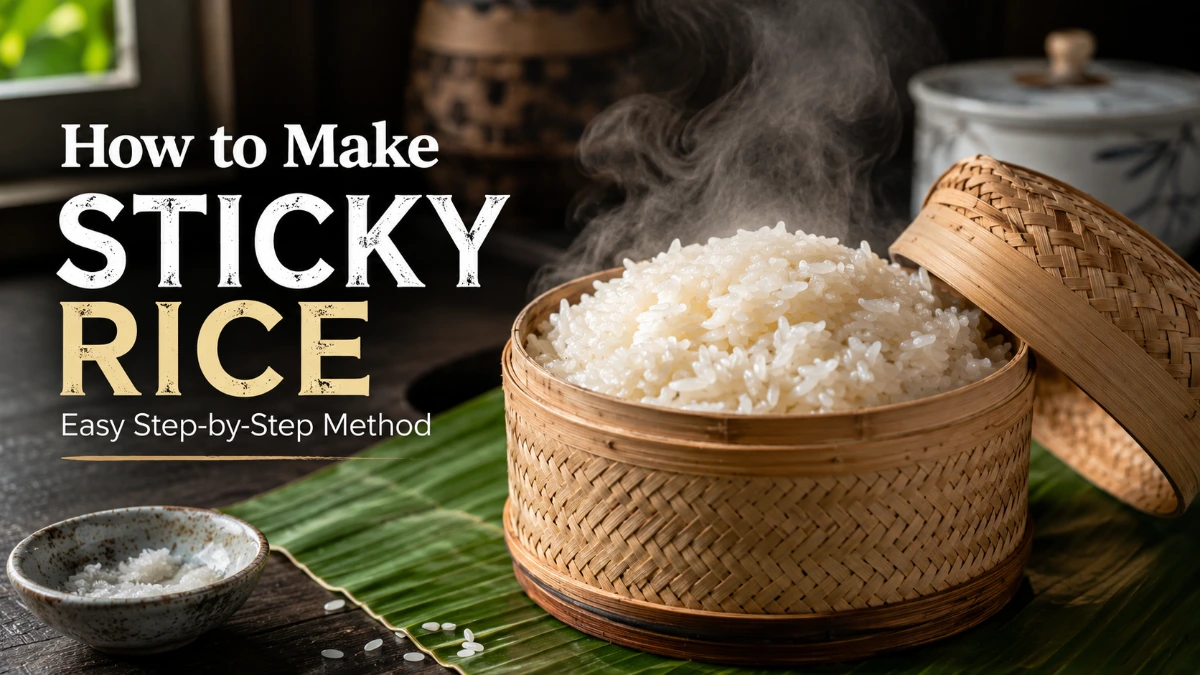
If you want to know how to Make Sticky Rice, start with the rice itself. True sticky rice comes from glutinous, sweet, or sticky rice, then soaked and cooked with steam rather than boiled like ordinary long-grain rice. Using the right rice and giving it enough time to absorb water are the two most important steps.
This guide shows how to Make Sticky Rice with a straightforward steaming method, then explains what to do if the rice comes out hard, gluey, crumbly, or dry. It also covers ways to prepare it without a traditional steamer and how to handle rice cooker batches.
What You Need to Make Sticky Rice
Rice
Use rice specifically labeled:
- Glutinous rice
- Sweet rice
- Sticky rice
Despite the name, glutinous rice does not contain gluten. “Glutinous” describes its soft, clingy texture.
Jasmine, basmati, and other everyday long-grain rices are different. Their starch profiles encourage the grains to stay more separate, so they cannot reproduce the same texture as true glutinous rice.
Equipment
For the traditional method, you need:
- A pot
- A fine mesh strainer or steamer basket
- A cover or lid
- A bowl for rinsing and soaking
If you do not have a dedicated steamer, a fine mesh strainer set inside a regular pot can work as an improvised steaming setup.
How to Make Sticky Rice
The basic process is simple: rinse, soak, drain, steam, and rest.
1. Choose the Right Rice
The first step in How to Make Sticky Rice is choosing actual glutinous rice. Look for a package labeled “glutinous rice,” “sweet rice,” or “sticky rice,” commonly available from Thai or Chinese brands at Asian grocery stores or online.
No cooking technique can compensate for using the wrong variety.
2. Rinse the Rice
Rinse the rice two to three times in cold water until the water runs mostly clear.
Rinse gently rather than aggressively scrubbing the grains.
3. Soak the Rice
Soaking is one of the most important parts of How to Make Sticky Rice because the rice needs time to absorb water before it is exposed to heat.
For a quicker preparation, soak for 30 minutes to a few hours. For the most even results, soak overnight, or for at least 4 hours.
If you are short on time, soaking in hot water instead of cold can speed up the process. A hot-water soak can produce usable rice in roughly 30–60 minutes.
4. Drain the Rice
After soaking, drain the rice well before steaming.
The traditional approach relies on steam rather than cooking the rice submerged in water. This helps produce the characteristic soft, clingy texture of properly prepared glutinous rice.
5. Steam the Rice
Place the soaked and drained rice into a suitable steaming setup.
If you do not have a dedicated steamer, place a fine mesh strainer inside a regular pot over simmering water. Cover the pot and steam the rice.
Avoid piling the rice excessively thickly. Unevenly distributed rice can cook unevenly.
6. Check for Doneness
Knowing when sticky rice is ready is more useful than relying only on a clock.
Properly cooked sticky rice should look:
- Glossy
- Slightly translucent
- Tender
- Clingy without falling apart
When you bite into a grain, there should be no hard or gritty center.
If the center is still firm, return the rice to the steamer for a few more minutes.
7. Let the Rice Rest
Once the rice is cooked, let it rest covered for 5–10 minutes off the heat before serving.
This short rest helps even out the remaining moisture throughout the batch.
How to Make Sticky Rice Without a Steamer
You do not need specialized equipment to prepare sticky rice.
Fine Mesh Strainer Method
Set a fine mesh strainer inside a regular pot over simmering water. Add the soaked and drained rice, cover, and steam it much like you would in a proper steamer basket.
This is the closest alternative to the traditional steaming setup described in this guide.
Stovetop Absorption Method
If steaming is not possible, soaked rice can also be cooked on the stovetop with less water than you would normally use for regular rice.
Keep the heat low because sticky rice can scorch more easily over direct heat than fluffy long-grain varieties.
If the pot becomes dry before the rice is tender, add a splash of water.
This method can produce a clingier result, but it is different from the traditional steaming approach.
Microwave Method
For one or two servings, the microwave can be another option.
Soak and drain the rice as usual, then place it in a microwave-safe dish with a little water. Cover and cook in short bursts, stirring between each interval. Let it sit covered for a few minutes afterward.
This works best for small batches rather than a full quantity of rice.
How to Make Sticky Rice in a Rice Cooker
Rice cookers require slightly different handling.
Crumbly results usually come from two problems: too little water for the amount of rice or opening the lid immediately when the cooking cycle ends.
A useful starting point is roughly 2/3 cup of water per 1 cup of pre-soaked rice, with adjustments depending on your particular rice cooker and rice brand.
The most important step is what happens after the cooking cycle finishes.
Keep the lid closed and let the rice rest undisturbed for 10–15 minutes before opening it. Opening the lid too early can contribute to crumbly results because the rice has not finished settling and gelatinizing.
Why Is My Sticky Rice Hard in the Middle?
If you are learning How to Make Sticky Rice, a hard center is one of the most common problems.
Why it happens
The most likely cause is an insufficient soak.
Glutinous rice has a dense starch structure and needs time to absorb water before heat can properly gelatinize it. Rice that goes directly from the bag into the steamer can cook unevenly, leaving the center firm while the outside softens.
The fix
Soak the rice for 30 minutes to a few hours for a quicker meal, or overnight for the most even results.
If the finished rice is still hard, return it to the steamer for a few more minutes instead of starting over with a completely different recipe.
Why Did My Sticky Rice Turn Gluey?
Gluey, overly wet rice usually happens when the rice has been exposed to too much moisture or heat.
Common causes
- Too much water
- Rinsing too aggressively
- Overcooking
- Leaving the rice on heat after it is done
The fix
Use less water next time, rinse more gently, and check the rice for doneness earlier rather than relying only on the clock.
Proper sticky rice should be glossy and clingy, but it should still hold its texture instead of collapsing into a wet mass.
Why Is My Sticky Rice Crumbly?
Crumbly rice is especially common with rice cooker batches.
The two main culprits are insufficient water or opening the cooker lid too soon.
Start with roughly 2/3 cup of water per 1 cup of pre-soaked rice, then adjust slightly according to your cooker and rice brand.
After the cooking cycle ends, keep the lid closed and allow the rice to rest for 10–15 minutes.
Quick Reference: Problem-to-Fix Table
| Symptom | Root Cause | Action |
| Hard center | Skipped or short soak | Soak longer; extend cook time |
| Gluey, wet texture | Too much water, over-rinsing, or overcooking | Reduce water, rinse gently, check earlier |
| Uneven cooking in steamer | Rice piled too thick | Spread thinner, stir once midway |
| Crumbly rice cooker batch | Lid opened too soon after cooking | Rest undisturbed 10–15 minutes before opening |
| Sticking/scorching in cooker | Skipped rinse or lid opened early | Rinse thoroughly; let it rest fully |
| Dry, yellowish leftovers | Left on warm setting too long | Unplug promptly; store in fridge |
How to Store Sticky Rice
Sticky rice left on a rice cooker’s “warm” setting for extended periods gradually dries out and can discolor slightly.
Once cooking finishes, unplug the cooker instead of leaving the rice on warm for an extended period.
Transfer leftovers to an airtight container and store them in the fridge, where they will keep for a few days.
How to Reheat Sticky Rice
If you are wondering How to Make Sticky Rice and keep its texture for later, reheating matters too.
Rice becomes firmer as it cools, but a brief re-steam or microwave pass can restore much of its original softness.
For microwave reheating, use a damp paper towel or add a splash of water over the rice before reheating.
You can also re-steam leftover rice briefly to bring back its softer texture.
What to Serve With Sticky Rice
Once your technique is solid, sticky rice can be used in a wide range of dishes.
It works as a base or accompaniment for:
- Grilled meats
- Papaya salad in Lao and Thai cooking
- Mango sticky rice
- Rice balls
- Dim sum staples across Chinese cuisine
The basic preparation and troubleshooting principles above apply regardless of which dish you serve it with.
Final Takeaway
The key to How to Make Sticky Rice is not complicated equipment. Start with the correct glutinous rice, rinse it gently, give it enough time to soak, and use steaming as the primary cooking method.
If the rice is hard in the center, focus on the soak. If it is gluey, look at excess moisture and overcooking. If a rice cooker batch is crumbly, let it rest with the lid closed before opening it.
Once those fundamentals are right, sticky rice should come out glossy, tender, and naturally clingy rather than hard, watery, or crumbly.
Read more: How Many Calories Should I Eat a Day?
Frequently Asked Questions
The most common cause is an insufficient soak. Soak the rice for at least a few hours, or overnight for the most even results. If the cooked rice is still hard, return it to the steamer for a few more minutes.
Too much water, overly aggressive rinsing, or overcooking can produce an overly wet texture. Reduce the amount of water, rinse more gently, and check the rice for doneness earlier.
No. Jasmine rice has a different starch profile and cannot fully reproduce the clumping texture of glutinous rice. It can be cooked softer as an approximation, but it is not the same as true sticky rice.
Yes. A fine mesh strainer set inside a pot can provide an improvised steaming setup. A low-water stovetop absorption method or a microwave can also work, particularly for small portions.
You may have opened the lid too soon after the cooking cycle ended. Let the rice rest, covered and undisturbed, for 10–15 minutes before opening the cooker.
A useful starting point is roughly 2/3 cup of water per cup of pre-soaked rice. Adjust slightly according to your specific rice cooker and rice brand.
Glutinous rice itself does not contain gluten. The word “glutinous” refers to its texture rather than gluten. If you need to avoid gluten, check packaged products and preparation conditions for possible cross-contact.
Look for glossy, slightly translucent grains that feel tender and clingy without falling apart. When you bite into a grain, it should not have a hard or gritty center.
Briefly re-steam the rice or microwave it with a damp paper towel or a splash of water. This can restore much of the soft texture that firms up when the rice cools.
It was likely left on a rice cooker’s warm setting for too long. Unplug the cooker after cooking and transfer leftovers to an airtight container in the fridge instead.