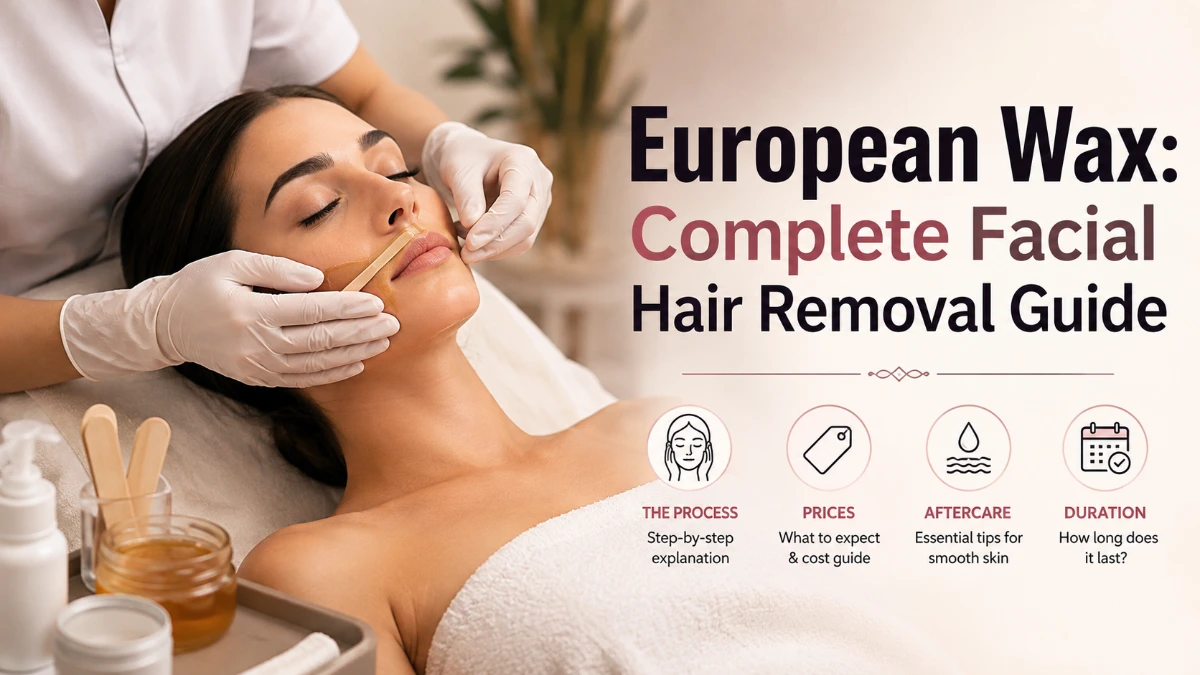
Before booking a facial waxing appointment, most people run into the same question: Is European wax a brand, a technique, or both? The short answer is both — it is associated with a specific wax formula and four-step method, and it is also closely associated with European Wax Center, the franchise that built a national business around that approach.
For facial hair removal, European wax involves removing hair from the root while following a preparation, waxing, and aftercare process designed to reduce unnecessary irritation. Facial areas commonly treated include the eyebrows, upper lip, lower lip, chin, cheeks, nose, ears, sideburns, and hairline.
Understanding whether you’re researching the waxing method, its cost, or the company behind it makes the rest of the process easier to evaluate.
What Is European Wax?
European wax can refer to both European Wax Center and a waxing approach used for professional hair removal. In the context of facial waxing, the method uses a hard or hybrid wax formula alongside a structured process that prepares the skin, removes hair from the root, and calms the treated area afterward.
Unlike shaving, which cuts hair at the skin’s surface, waxing removes the hair from the root. This means results generally remain noticeable for longer before regrowth appears.
Untangling the Term: Brand or Technique?
Ask ten people what “European wax” means, and you’ll get two different but correct answers.
For some, it’s shorthand for European Wax Center — a publicly traded company (ticker EWCZ) operating hundreds of locations across the U.S., each one delivering a standardized service.
For others, it’s simply a category of wax application: a hard or hybrid formula, adopted beyond that one brand, that many independent estheticians use for sensitive areas such as the face.
For someone considering facial hair removal, the practical questions are usually similar either way: how the process works, what areas can be treated, how much it costs, how long the results last, and how it compares with alternatives such as threading and sugaring.
European Wax Center: Locations, Booking & What to Expect
When people search for “European wax,” they are often looking for nearby services or booking options. European Wax Center operates through franchised locations, which means pricing, promotions, and service menus can vary slightly by location.
Most locations offer:
- Individual facial services (lip, chin, brows)
- Full-face packages
- First-time guest offers (location-dependent)
- Wax passes for regular clients
Before booking, it’s worth checking:
- Current pricing at your nearest location
- Available promotions
- Whether you need a full-face service or just specific areas
This step matters because the “European wax” experience is not only about the method — it’s also about how consistently the service is delivered across locations.
Where the Method Came From
The technique’s popularity traces back to a real business story. European Wax Center opened its doors in 2004, founded by a family that wanted a gentler alternative to the hot-wax norm of the time. Rather than keep the concept small, the founders scaled through franchising, which let the brand expand quickly while locations followed a standardized protocol.
That consistency became an important part of the concept. By treating the wax formula and four-step process as something proprietary — not just another service on a salon menu — the company created a recognizable approach to professional waxing.
The business eventually went public and has since branched into skincare treatments alongside waxing.
How the Four-Step European Wax Process Works
Strip away the branding and the actual mechanics of European wax are straightforward, built around four repeatable steps applied to facial areas:
- Cleanse — the skin is wiped clean of oil, makeup, or residue so the wax can grip hair rather than skip over buildup.
- Protect — a pre-wax oil or powder forms a thin barrier, reducing how much the wax pulls at the skin itself.
- Wax — the formula goes on and comes off against the direction of hair growth, lifting hair out at the root.
- Refresh — a calming, often oil-based serum — reduces redness and helps skin recover right after.
Why does this sequence matter more on a face than, say, a leg? Facial skin can be particularly sensitive, so careful preparation, wax application, removal, and aftercare all matter.
The goal is straightforward: remove the hair effectively while minimizing unnecessary stress on the surrounding skin.
What It Actually Feels Like (Real Experience Layer)
Pain tolerance varies, but facial waxing is not equally uncomfortable across all areas:
- Upper lip: often the most sensitive area
- Eyebrows: moderate discomfort due to thinner skin
- Chin & cheeks: generally milder
Most people describe the sensation as quick rather than prolonged. The discomfort happens during removal and fades quickly, while redness may last a few hours depending on skin sensitivity.
What Areas Can Be Treated With European Wax?
Facial waxing isn’t sold as one flat service. It’s broken into specific zones, and understanding that breakdown helps explain the pricing structure.
Eyebrows, upper lip, lower lip, chin, cheeks, nose, ears, sideburns, and hairline are each treated as distinct services, with a bundled full-face option available.
Eyebrows tend to be an entry point for many clients — often the first professional wax someone tries before adding lip, chin, or other facial treatments later.
European waxing is not limited to the face. Professional waxing services can also cover other body areas. However, this guide focuses primarily on facial European wax, where skin preparation, precision, and aftercare are especially important.
How Much Does European Wax Cost?
The price of a European wax depends on the area being treated. Facial services are normally priced individually, while clients treating several areas may have the option of choosing a full-face service.
Here is how individual facial pricing can break down based on the rate information used for this guide:
| Facial Area | Approximate Price Range |
| Lower Lip | $10.50–$18 |
| Upper Lip | $16–$18 |
| Chin | $16 |
| Nose | $18 |
| Eyebrows | $18–$29 |
| Sideburns | $20 |
| Cheeks | $20 |
| Full Face | $59–$64 |
These figures should be treated as approximate pricing rather than guaranteed rates. Prices can shift by location and available promotions, so checking the current price at the location where you plan to book is important.
Some locations also offer wax passes for regular clients, while first-time guest promotions may be available depending on the location and current offer.
Deciding Between Single Areas and a Full-Face Package
If your concern is limited to one or two spots — a few chin hairs, for example, or just the upper lip — booking individually usually costs less than paying for a bundle you don’t need.
But once you’re treating several facial zones regularly, comparing the combined individual prices with the available full-face option makes sense.
The deciding factor should be how many areas you actually want treated and the current pricing at your chosen location, rather than simply choosing the largest package available.
How Long Does European Wax Last?
Because waxing removes hair from the root rather than cutting it at the skin’s surface, results generally last longer than shaving.
For facial waxing, smoothness can typically last around three to four weeks before noticeable regrowth, although the exact timing can vary from person to person.
The practical way to judge the results is to watch how your own hair grows back after the first few appointments. Some areas may become noticeable sooner than others.
Does European Wax Reduce Hair Growth Over Time?
Waxing removes hair from the root repeatedly, which may lead to slower or finer regrowth for some individuals over time. However, results vary based on hair type, hormones, and consistency of appointments.
It should not be treated as a permanent hair removal method.
How Often Should You Get a European Wax?
There isn’t one schedule that works equally well for every person.
Since facial waxing results generally last around three to four weeks, that range can provide a practical starting point for deciding when another appointment may be needed.
Your actual schedule should depend on how quickly the treated hair becomes noticeable again and whether there is enough regrowth for the wax to grip effectively.
European Wax vs Regular Wax
The main distinction discussed with European wax is not simply whether wax is being used, but how the skin is prepared, how the formula interacts with the hair, and what happens after removal.
The four-step process — cleanse, protect, wax, and refresh — creates a standardized sequence around the waxing itself.
Traditional waxing services can vary considerably depending on the salon, formula, temperature, and technique being used. Because of that variation, the better comparison is not simply “European wax versus wax,” but the complete process and formula used during a particular service.
For facial areas, careful preparation and controlled removal are especially important because irritation can be more noticeable.
European Wax vs Threading, Sugaring, and Shaving
Waxing is one option among several, and each method trades off differently between convenience, precision, and how long results last.
| Method | How Hair Is Removed | Typical Result | Key Strength |
| European Wax | Hair removed from the root | Around 3–4 weeks | Treats defined facial areas efficiently |
| Shaving | Hair cut at the surface | Regrowth can appear quickly | Fast and inexpensive |
| Threading | Hair removed using twisted thread | Longer-lasting than surface removal | Precise eyebrow shaping |
| Sugaring | Hair removed using sugar-based paste | Longer-lasting root removal | Alternative to waxing |
Waxing pulls hair out at the root, generally keeping skin smooth for three to four weeks. Shaving only cuts hair at the surface, so regrowth can show up again within a day or two.
Threading uses twisted thread for precise, line-by-line hair removal, which is why it’s often favored specifically for eyebrow shaping. Sugaring applies a sugar-based paste against hair growth and removes it in the direction of growth.
None of these methods “wins” outright — the better choice depends on your priorities.
European Wax vs At-Home Wax Kits
At-home waxing kits offer convenience and lower cost, but they lack the consistency and precision of professional services.
Professional European waxing:
- Follows a structured process
- Uses controlled application techniques
- Reduces risk of uneven removal
At-home waxing:
- Can be inconsistent
- Requires more practice
- May increase chances of irritation if done incorrectly
For facial areas, many people prefer professional services due to the precision required.
Benefits and Drawbacks of European Wax
European wax can be useful for someone who wants longer-lasting facial hair removal without having to shave frequently.
Potential Benefits
- Removes hair from the root, allowing results to last longer than shaving
- Multiple facial areas can be treated, including eyebrows, lips, chin, cheeks, and sideburns
- A standardized four-step process covers preparation, waxing, and immediate aftercare
- Full-face options can simplify treatment when several facial areas need waxing
- Professional application reduces the need to manage waxing yourself
Potential Drawbacks
- Temporary redness or irritation can occur after waxing
- Sensitive facial areas can be uncomfortable during hair removal
- Regular appointments may be required as the hair grows back
- Some skin conditions or skincare products can make waxing temporarily unsuitable
- Professional waxing costs more per session than shaving at home
Is European Wax Worth It?
European waxing is generally worth considering if:
- You want longer-lasting results than shaving
- You prefer professional precision for facial areas
- You are comfortable with routine maintenance every few weeks
It may be less suitable if:
- You have highly sensitive or compromised skin
- You prefer a completely painless option
- You want a permanent solution
Managing Pain and Preparing Your Skin
Pain tolerance is personal, but some facial areas can feel more sensitive than others during waxing. The upper lip, for example, may feel more uncomfortable than areas where the skin is less sensitive.
One of the most important preparation steps is allowing enough hair growth for the wax to grip cleanly. Hair that is too short can be harder to remove effectively.
Skincare also deserves attention before facial waxing. Retinol and exfoliating products can leave skin more vulnerable to irritation, so people using these products should be particularly cautious about waxing recently treated skin.
The safest approach is to tell the professional performing the service about products that may be affecting your skin before waxing begins.
After the Wax: What Actually Helps
The hours right after a facial wax matter for your skin’s recovery. A short list of habits can help avoid unnecessary irritation:
- Leave the area alone for a few hours to limit unnecessary touching
- Hold off on makeup in the treated area for at least 24 hours
- Apply sunscreen, since freshly waxed skin can be more sensitive
- Skip hot showers, saunas, or heavy sweating right afterward
- Stick to an oil-free, non-comedogenic moisturizer
Anyone with active acne, sunburned skin, or skin affected by retinoid use should be cautious about facial waxing. Waxing already irritated or compromised skin can increase the chance of additional irritation.
Booking Your First European Wax Appointment
If you’re trying European wax for the first time, promotions may sometimes be available for new guests, depending on the location and current offer.
Pricing and exact service menus vary by location, so it’s worth checking a specific salon’s current offerings before you book, especially if you’re weighing a full-face package against individual areas.
Before booking, decide which areas actually bother you. Someone who only wants eyebrow shaping or upper-lip hair removal may have little reason to pay for a full-face service.
The real test comes after your first session or two: how quickly redness fades, how long you go before regrowth, and how your skin generally reacts.
That feedback is what tells you whether facial waxing is worth sticking with long-term or whether an alternative such as threading, sugaring, or shaving better fits your needs.
Frequently Asked Questions
It’s both. European Wax Center is a specific franchised company, while “European wax” can also refer to the waxing approach associated with professional hair removal and a structured waxing process.
Not exactly. European Wax Center refers to the specific company and its locations, while European wax may be used more broadly when people are researching the waxing method.
Common zones include eyebrows, upper lip, lower lip, chin, cheeks, nose, ears, sideburns, and hairline, plus a bundled full-face option.
Full-face services can run approximately $59 to $64, while individual facial areas range from about $10.50 to $29, depending on location and offers.
It is associated with a structured four-step method — cleanse, protect, wax, and refresh — while traditional waxing methods can vary.
Results typically last around three to four weeks before noticeable regrowth.
A three-to-four-week interval is a practical starting point, depending on hair growth.
Hair needs enough length for the wax to grip effectively; very short hair may not be removed properly.
Be cautious with retinol and exfoliating products before waxing because they can increase skin sensitivity.
It can be suitable for some people, but those with active acne, irritation, or recent retinoid use should be cautious.
Avoid touching the area, skip makeup for 24 hours, use sunscreen, avoid heat exposure, and keep skincare gentle.